AI Is Here, But Where Is the Pedagogy? Meaningful Integration with AI-TPACK

In our webinar, we put on the table a problem teachers frequently face when integrating AI into the classroom: access is no longer the issue, the real challenge is using these tools with pedagogical meaning. Guided by Assoc. Prof. Selçuk Doğan, we explored the AI-TPACK framework, which has moved to the centre of education research in recent years, and drew a concrete roadmap for teachers.
**Highlights from Our Webinar
**
🔹 The real issue is not access, but meaningful use
Opening the webinar, Assoc. Prof. Selçuk Doğan made a clear observation: today, everyone has access to AI. In fact, we interact with different tools many times a day. The real problem is using these tools in a pedagogically meaningful and ethical way.
“Preparing a lesson plan with ChatGPT does not mean I have achieved pedagogical integration. I save time, yes. But it does not mean our teaching or our learning has deepened.”
This sentence from Selçuk Doğan captured the webinar’s core motivation. Technology and pedagogy are never equals, and as AI advances, pedagogical expertise becomes more valuable.
🔹 How teachers use chatbots
Research shows that teachers use chatbots for roughly 15 to 17 different purposes. The range is wide, from intelligent tutoring to data analysis, from producing materials to setting pupil tasks. But these cluster into three core categories: planning, implementation and assessment.
Worldwide, the most common use today is for planning. Lesson plans, activities, materials, presentations, rubrics. In other words, everything that happens before walking into the lesson. Implementation and assessment, that is, use during and after the lesson, are far less common.
What Selçuk Doğan underlined here was a problem of balance: *“Pre-lesson use is very intensive, while use during and after the lesson is much rarer. The way to increase it is to adopt a model.”
*
🔹 Why we need a new framework
Selçuk Doğan set out four core reasons:
First, using the tool is no longer the issue. Access to chatbots is now in everyone’s hands. The real task is designing learning. We need to ask questions like: for which pupil, when, with which pedagogy, and is it even necessary?
Second, AI can magnify pedagogical mistakes. Poor pedagogy spreads faster with technology. A superficial plan that would take us half an hour, AI produces in a minute. But the content is just as superficial. AI can also generate risks around accuracy, fairness and inclusivity.
Third, teaching is no longer about transmitting content. The teacher is in the position of an orchestra conductor. Pupils can do the foundational learning at home with AI. The teacher’s role is changing in this process, not losing its value.
Fourth, pedagogical expertise is becoming more valuable. In Selçuk Doğan’s words: *“The teacher will never be left outside the system. They will become a more valuable part of it. But we need to get there by learning.”
*
🔹 The AI-TPACK model: pedagogy, content, technology and ethics together
TPACK is a model that was used in educational technology long before AI. T stands for technology, P for pedagogy, C for content. Where the three intersect is integrated knowledge. In the AI era, this model has evolved and an ethical dimension has been wrapped around it. One of the best-known versions today is the AI-TPACK model published in 2023 by the Turkish academic İsmail Çelik.
Selçuk Doğan walked through the model in five elements:
AI-TK (AI technological knowledge): Knowing how to interact with a chatbot, how to write prompts, and what the tool is technically capable of. Critical oversight is essential here. You need to be able to judge whether to trust the sources it produces.
AI-TPK (AI pedagogical knowledge): Technical knowledge is not enough. It has to be combined with pedagogy. For a mathematics teacher, how will AI be integrated into the pedagogy of problem solving? A teacher using the 5E model should know whether the chatbot they choose fits that model.
AI-TCK (AI content knowledge): Knowledge of AI use specific to your subject. For a chemistry teacher, which tool produces better simulations for acids and bases? In the sciences, can you follow current discoveries and curriculum updates with AI?
AI-TPACK (integrated practice knowledge): Bringing it all together. In Selçuk Doğan’s words: “Being like a good chef. Combining the right ingredients with the right technique and the right tools.” It is a kind of knowledge that has to enter the classroom, be tried out, and be revised.
The ethical dimension: A layer that wraps around the whole model. Fairness, inclusivity, responsibility, accountability. Selçuk Doğan highlighted one research finding in particular: *“A teacher should spend at least twice as long thinking about the ethical side as they spend designing the lesson.”
*
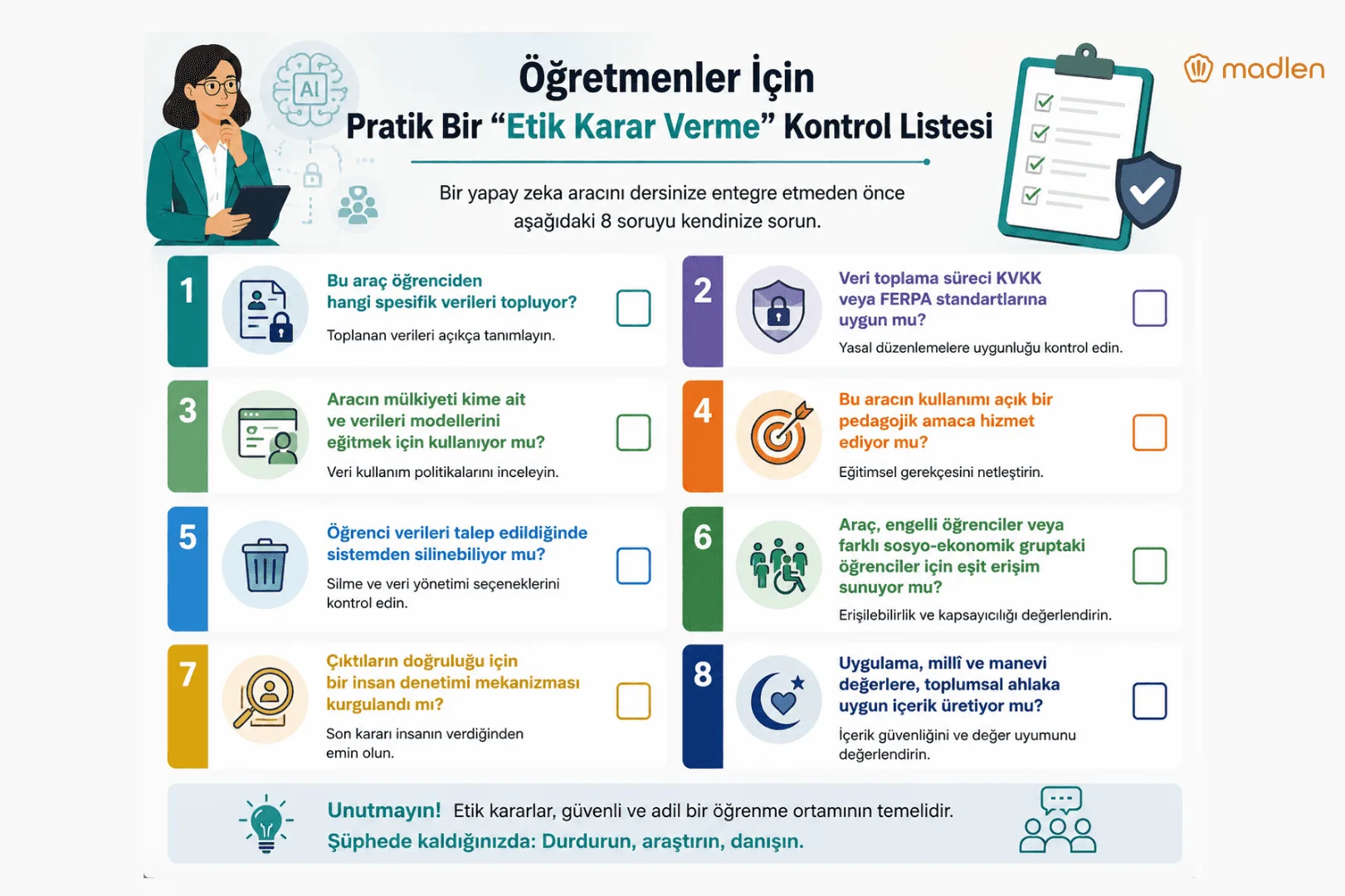
🔹 An ethical decision-making checklist
We shared an eight-point ethical decision-making checklist that Selçuk Doğan compiled from academic papers and his own reading:
What information does this tool collect from pupils? Does the data collection comply with the relevant legal frameworks (KVKK, COPPA, FERPA)? Who owns the tool? Is its pedagogical purpose clear? Can pupil data be deleted on request? Can equal access be ensured across socio-economic groups? Is there scope for supervision and monitoring in the classroom? Is alignment with the curriculum being checked?
Selçuk Doğan’s note here mattered: “Ethical decisions are the foundation of a safe and fair learning environment. While focusing on pedagogy and design, we sometimes miss this.”
**
🔹 Paths for development**
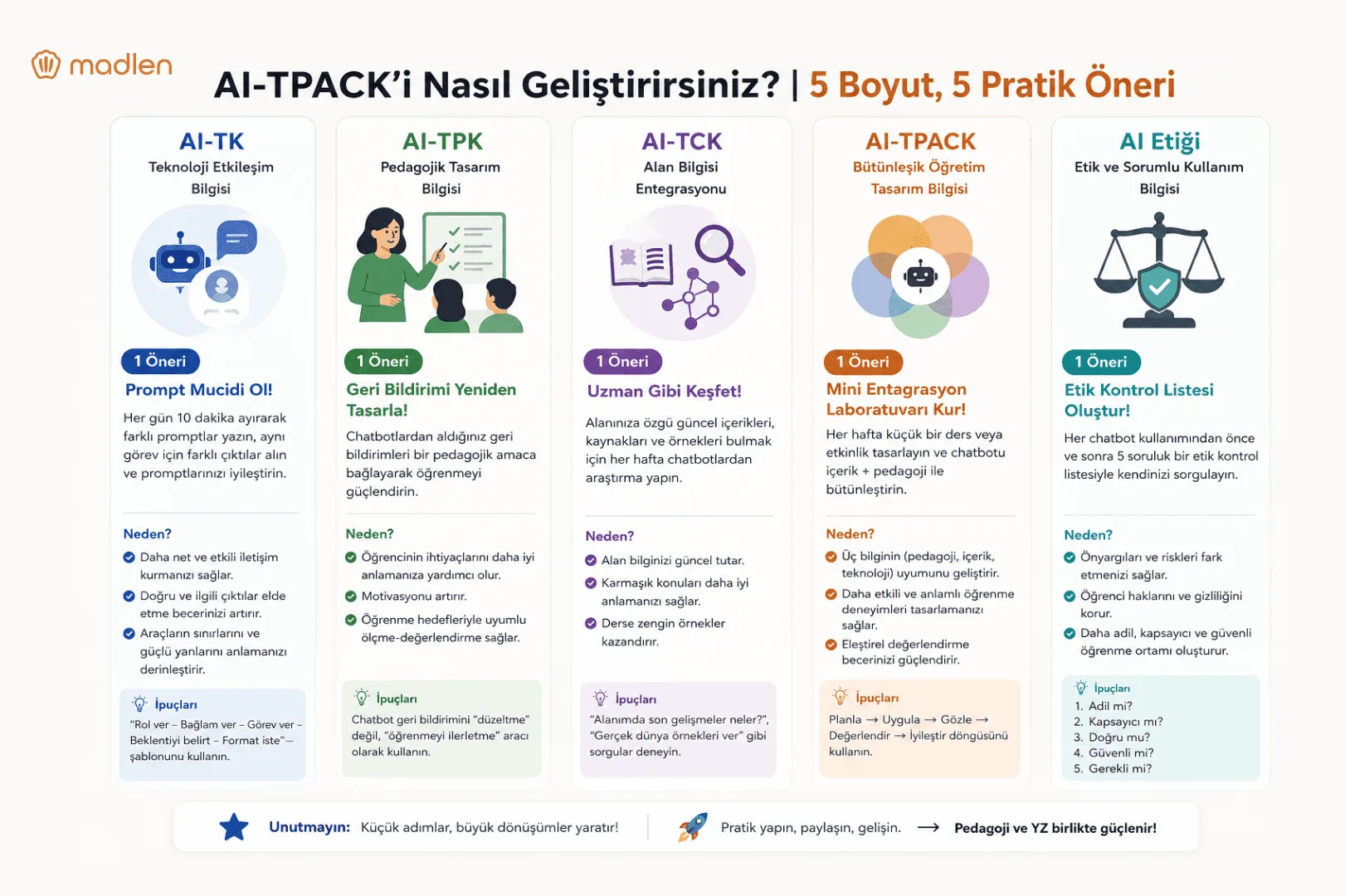
At the end of the webinar, Selçuk Doğan offered practical suggestions for anyone wanting to develop all five dimensions of AI-TPACK:
For prompt writing: Move from single-sentence prompts to a role-context-task-format template. Providing context alone produces far higher-quality output from AI models.
For design: Tie the feedback coming from chatbots to a pedagogical purpose. When the pupil’s interests and profile enter the picture, the effect on attainment is debatable, but motivation definitely rises.
For content: Use deep research mode in Google to catch up-to-date sources. But always keep hold of critical thinking.
For integration: Rather than using the chatbot on its own, bring it into the classroom. Selçuk Doğan’s potato example was a good one: pupils first read an article, then create a podcast with AI, compare the two, spot the errors in the podcast, and build their own arguments. An activity that merely generates images is not enough for AI-TPACK. Plan, apply in the classroom, observe, assess, improve.
For ethics: Build your own checklist. Take the eight points Selçuk Doğan shared as a starting point and adapt them to your own classroom and pupil profile.
**
Building Pedagogical Capacity Together**
At Madlen, we believe AI is not a replacement for the teacher but a thinking partner that deepens the teacher’s pedagogical expertise. The AI-TPACK framework shows us how to build that partnership: when technology, pedagogy, content and ethics are considered together, genuine transformation in the classroom becomes possible. The teacher’s voice, touch and expertise are an indispensable part of this process.
You can watch the webinar recording here: