An AI Guide for Parents: My Child Is Using AI at School, What Should I Know?

Over dinner, your child tells you: “We worked with AI in class today.” A flurry of questions comes to mind. Is this safe? Where does my child’s information go? Is it helping them learn, or making them lazy?
These are fair questions. This article was written for parents whose children are encountering AI at school. We explain what you are dealing with, what rights you have, and which questions you can put to the school.
AI at school is now bound by a framework
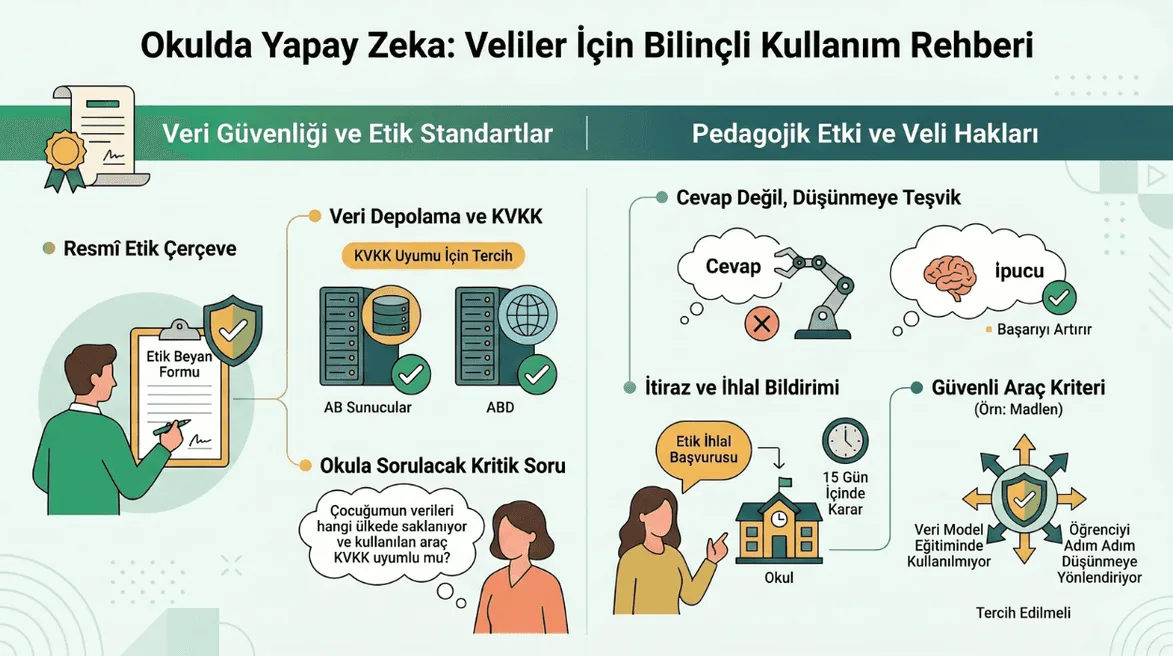
Let’s start with the good news. In Türkiye, the use of AI in schools has been governed by an official framework since late 2025. The Ministry of National Education (MoNE) has published both an Ethics Committee Directive and an Ethical Guide. Teachers now complete an Ethical Declaration Form before using AI with pupils.
So if AI is being used in your child’s classroom, it is not a free-for-all. Behind it sits a declaration completed by the teacher, an ethics team at school level and, when needed, an appeal mechanism you can turn to.
Is my child’s data safe?
This is the most important question to ask. Because when your child’s essay or homework is uploaded to an AI tool, it counts as personal data processing, even if their name has been removed.
The truly critical point is where the data is stored. Most mainstream AI tools process data on servers in the United States. Transferring data from Türkiye to the US is subject to strict conditions under Turkish data protection law (Law No. 6698). Keeping the data within the borders of the European Union is both legally clearer and better protected.
You can ask the school: “Which tool holds my child’s data, in which country is it stored, and is the tool compliant with Turkish data protection law?” That question should have a clear answer.
Will AI harm my child’s learning?
The research paints a nuanced picture here. An AI that hands over the answer directly can stop a child from thinking. A study conducted with secondary school pupils in Türkiye and published in PNAS found that pupils who received ready-made answers performed worse in the exam.
But the same study showed that pupils who worked with an AI that offered hints and asked questions instead of giving answers preserved their learning gains. In other words, the problem is not AI itself, but whether it gives the child the answer or nudges them to think.
The same principle applies at home. When your child says “do this for me” to an AI while doing homework, they are not learning. When they say “help me understand where I am stuck”, they are. Explaining that distinction to them works better than banning the tool outright.
Your rights as a parent
The directive gives parents a concrete right of appeal. If you see something ethically troubling in an AI application:
-
You can first report an ethical violation to the school. The school’s team reviews it and decides within 15 days.
-
If you are not satisfied with the decision, you can appeal to the provincial or district committee.
-
If necessary, the process goes all the way up to the Supreme Committee.
If a violation is found, the application is halted. In other words, there is an address where your voice will be heard.
Questions you can ask the school
At a parents’ evening or in a meeting with the teacher, asking the following will make things easier:
-
Which AI tool is used in the classroom?
-
Where is my child’s data stored, and is it compliant with Turkish data protection law?
-
Does the AI give the child the answer, or does it guide them to think?
-
How is it ensured that the work my child produces remains their own?
What does Madlen offer parents?
Madlen was designed to answer these questions from the outset. Pupil data is stored within the European Union, on servers in Germany; it is not transferred to the US and it is not used to train models. When a pupil asks a question in Madlen School, the system does not give the answer directly, it guides the child to think step by step.
So if your child uses Madlen, their data is protected to European Union standards, and the AI pushes them to think rather than thinking for them.
Sources
-
MoNE Directive on the Ethics Committee for Artificial Intelligence Applications (22 October 2025).
-
Ministry of National Education (2026). Ethical Guide for Artificial Intelligence Applications in Education.
-
Law No. 6698 on the Protection of Personal Data (2016).
-
Bastani, H. et al. (2025). Generative AI without guardrails can harm learning. PNAS, 122(26).