
How to Prepare a TYMM Lesson Plan: A Daily Lesson Plan Aligned with the Maarif Model

Understanding what the Türkiye Century Education Model (TYMM) is is one thing; turning it into a daily lesson plan you can actually use in the classroom is quite another. Many teachers are asking the same question: “Fine, the competent and virtuous person, learning outcomes, cross-curricular components… but how do these fit into a daily lesson plan?”
In this post, we summarise the building blocks of a TYMM-aligned daily lesson plan and the preparation process in four steps.
(If you have not yet read about what TYMM is, the competent and virtuous person profile, and the learning outcomes framework, start here first: What is the Türkiye Century Education Model (TYMM)?)
What goes into a TYMM daily lesson plan?
The old plan template lived in most teachers’ minds like this: write the learning objective, write the topic, write the activities, write the assessment tool, done. TYMM has changed that structure from the ground up.
The new plan now includes the following:
In the old plan | In the TYMM plan |
Learning objective | Learning outcome + related skills |
Topic | Content framework + interdisciplinary connections |
Activities | Learning-teaching practices + teaching methods |
Assessment | Evidence of learning (multiple sources) |
(Not included) | Pre-assessment process |
(Not included) | Bridge building |
(Not included) | Cross-curricular components (SEL, values, literacy) |
(Not included) | Differentiation (enrichment + support) |
(Not included) | Core assumptions |
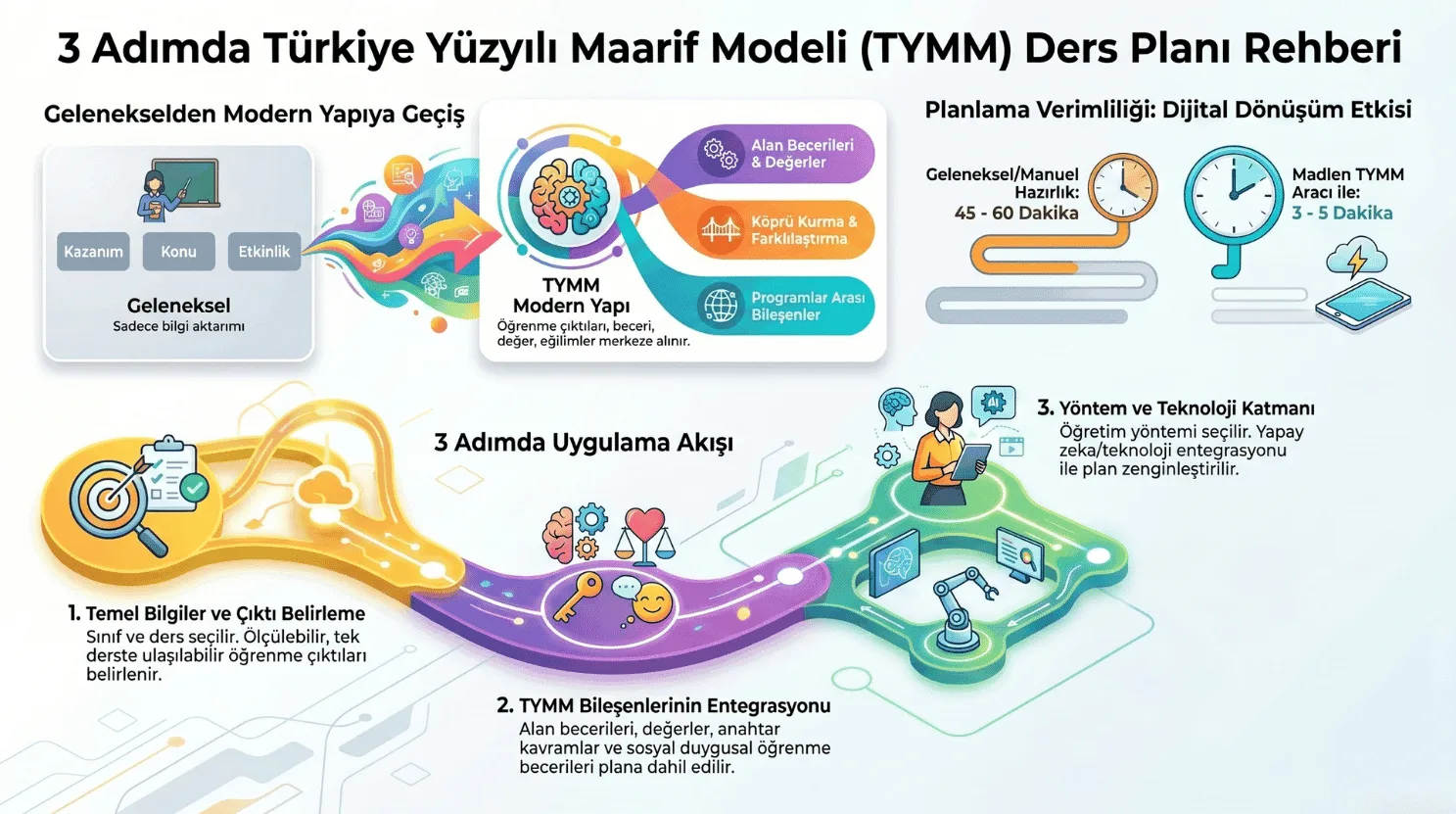
Madlen’s Maarif Daily Lesson Plan tool breaks this structure into a four-step flow: Basic Information, TYMM, Learning Methods, Additional Details.
Step 1: Basic Information
In the first step, the skeleton of the plan is chosen: year group, subject and output language. As soon as the selection is made, the system automatically brings in the units and official learning outcomes for that year group from the Ministry of National Education (MoNE) curriculum. The teacher opens the relevant unit and ticks the outcomes they will cover in the lesson. If they want to add an outcome that is not on the list, they can use the “Add Custom Learning Outcome” field.
There are three golden rules for choosing outcomes: it should be achievable within a single lesson, it should match pupils’ current level of knowledge, and it should be measurable and observable. Rather than squeezing three or four outcomes into a 40-minute lesson, focusing on one or two gives far more realistic results.
Step 2: TYMM components
The second step is the densest part of the plan. All of TYMM’s building blocks come together here. Based on the selected learning outcomes, Madlen automatically fills in every related component from the MoNE curriculum. The teacher’s job is to remove anything that does not fit their class, or add to it where needed.
The components that come in at this step:
-
Field Skills and Inter-Skill Relationships: The subject-specific and general skills the outcome rests on.
-
Key Concepts: The core terms to be explained in the lesson.
-
Values: The values from the virtue-value-action framework that best fit the topic.
-
Dispositions: Attitudes towards learning such as curiosity, empathy and analytical thinking.
-
Interdisciplinary Relationships: How the topic connects with other subjects.
-
Social-Emotional Learning Skills and Literacy Skills: The cross-curricular components.
-
Content Framework: The sub-headings of the topic.
-
Conceptual Skills: Higher-order cognitive skills such as inquiry and problem solving.
-
Core Assumptions: What we assume pupils already know.
-
Pre-Assessment Process: How we will test those assumptions.
-
Bridge Building: How the new topic will connect with prior knowledge and everyday life.
-
Learning-Teaching Practices: The activity flow of the lesson.
-
Enrichment and Support: Differentiation strategies.
-
Measuring Evidence of Learning: Assessment methods drawing on multiple sources.
All of these components are visible on the plan. Not every one of them needs to be covered with the same intensity in every lesson, but they form the skeleton of the plan.
Step 3: Learning Methods
In the third step, the pedagogical approach of the lesson is set. Two choices are made:
Teaching method (up to three): Direct instruction, cooperative learning, group discussion, whole-class discussion, active learning, learning by experiment. For a lesson introducing a new topic, a combination of direct instruction + cooperative learning works well, while for a consolidation lesson, group discussion + active learning is a better fit.
Teaching approach: A preference is set on a slider running from teacher-centred to pupil-centred. TYMM emphasises the pupil’s active role, but not every lesson has to be 100% pupil-centred. Balanced (50) for a new topic and pupil-centred (75) for consolidation are sensible choices.
Step 4: Additional Arrangements
The fourth step is optional but enriches the plan. There are five sub-headings: differentiation (extra strategies specific to your class), technology integration, artificial intelligence integration, fun activities, and additional instructions.
When artificial intelligence integration is planned, completing the YAZEK Ethics Declaration Form becomes mandatory. For the details: What is YAZEK? A guide to MoNE’s Ethics Declaration System for Artificial Intelligence Applications
How long does the process take?
Planning TYMM’s building blocks by hand from scratch takes roughly 45-60 minutes. A teacher delivers an average of 20-25 lesson hours a week, which adds up to a weekly planning load of 15-20 hours.
With Madlen’s four-step flow, a plan of the same scope is ready in 3-5 minutes on average. Learning outcomes are selected, the TYMM components the system brings in are reviewed, anything that does not fit the class is removed, the teaching method is chosen, and the plan is done. The output can be printed directly, downloaded as a PDF, or edited further.
To try the Maarif Daily Lesson Plan: teacher.madlen.io
Sources:
- Ministry of National Education (2025). Türkiye Yüzyılı Maarif Modeli Öğretim Programları Ortak Metni. Talim ve Terbiye Kurulu Başkanlığı, Ankara.