How to Set Up an AI Ethics Team at Your School

The Ministry of National Education (MoNE) Directive on AI Applications Ethics Committees, which came into force on 22 October 2025, gives every school in Türkiye a concrete task: setting up its own AI ethics team. In this post we explain who makes up the team, what it is responsible for, and what you need to do, step by step, as a headteacher.
What is a school AI ethics team?
The directive ties AI oversight to a three-tier structure. At the top sits the Supreme Committee within the Board of Education; in the middle, provincial and district committees; and at the bottom, school AI ethics teams. Everything that happens in the classroom starts at the bottom tier.
In other words, the school team is the first stop in the field. When a teacher uses AI in class, when a parent raises a concern, or when an application conflicts with the ethical principles, the first review happens within this team.
Who makes up the team?
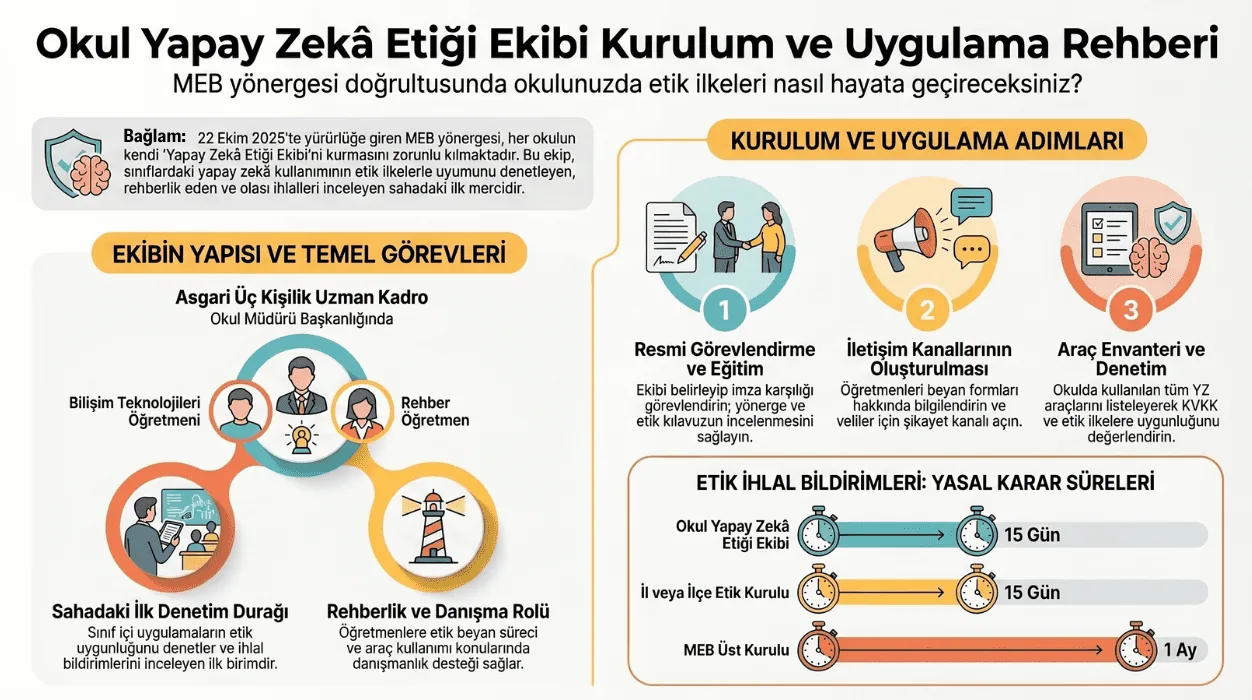
Article 13 of the directive defines the structure clearly: the team consists of at least three members, chaired by the school head, and is established by the school administration.
Three people is the lower limit. You can expand the team depending on the size of the school and how intensively AI is used. Who you choose is left to you. A combination that works well in practice looks like this:
-
The school head (chair)
-
A teacher who is comfortable with technology (IT, science, or someone who actively uses AI tools)
-
A school counsellor (someone sensitive to pupil data and privacy)
The scope is not limited to state schools. Private schools, Science and Art Centres (BİLSEM) and public education centres also set up their own teams.
What are the team’s duties?
The directive gives the team three core duties.
First, ensuring that AI applications at the school are run in line with the directive and the Ethical Guide for AI Applications in Education. When teachers use AI in the classroom, the team watches that they stay within the rules.
Second, guidance and support. When a teacher asks “Does using this tool require a declaration?”, the team is the body that provides the answer. This duty turns the team from a disciplinary unit into a point of consultation.
Third, reviewing and ruling on reports of ethical violations. When an issue is reported, the team is the first to open the file.
What happens when an ethical violation is reported?
Article 16 of the directive defines the process step by step. A report is first made to the school. The school team reviews it within 15 days, reaches a decision, and informs the parties concerned.
If the decision is appealed, the file goes to the provincial or district committee, which also rules within 15 days. The third avenue of appeal is the Supreme Committee, which concludes the matter within one month of the appeal date.
One point should not be missed. If the team or a higher body finds an ethical violation in an application, that application is halted. The team’s decision is not symbolic; it has direct consequences.
What should you do, step by step, as a headteacher?
-
Choose the team. At least three people, including the head. Prepare an assignment letter to be signed on receipt.
-
Have the team read the directive and the Ethical Guide. The eight ethical principles and the Ethical Declaration Form process should become the team’s shared language.
-
Inform the teachers. Explain clearly in which situations the Ethical Declaration Form must be completed and who to bring their questions to.
-
Open a reporting channel. Parents and pupils should know where to turn when they want to raise a concern.
-
Review the tools in use. List which AI tools are used at the school and which of them touch pupil data.
The first four steps can be completed within a few days. The real work is in the fifth step: assessing whether the tools used at the school are genuinely appropriate in terms of data protection law and the ethical principles.
How does Madlen make the team’s job easier?
Where the team will spend the most time is checking whether the tools in use are safe. Madlen was built to meet that scrutiny from the start.
Teacher and pupil data is stored on Infercom infrastructure, on servers in Germany, within the borders of the European Union. No data is transferred to the US, and data is never used to train models. This is exactly what the Ethical Guide’s “Privacy, Confidentiality and Data Governance” principle requires. You can find the details in the data protection guide we prepared for school leaders.
Every Madlen output passes through teacher review, and no tool grades a pupil directly. In other words, the “final responsibility rests with a human” principle is protected at the infrastructure level. Your team does not need to research these criteria one by one when reviewing a Madlen application.
Sources
-
MoNE Directive on AI Applications Ethics Committees (22 October 2025).
-
Ministry of National Education (2026). Ethical Guide for AI Applications in Education. Board of Education, Ankara.
-
Law No. 6698 on the Protection of Personal Data (2016).