Teachers' 5 Most Common Worries About AI, and the Reality

Whenever artificial intelligence comes up, two voices rise in the staffroom: excitement on one side, worry on the other. Most of the worries are not unfounded. But some of them are fed by incomplete information or by misuse.
At the end of five events it ran over the winter of 2025-2026, the Stanford Accelerator for Learning compiled the five most common myths about AI in education. In this post we take that framework, produced with contributions from Stanford HAI, ETS and the Stanford Graduate School of Education, and set it alongside the day-to-day worries of teachers in Türkiye and the research from the field.
Worry 1: “AI is going to take my job”
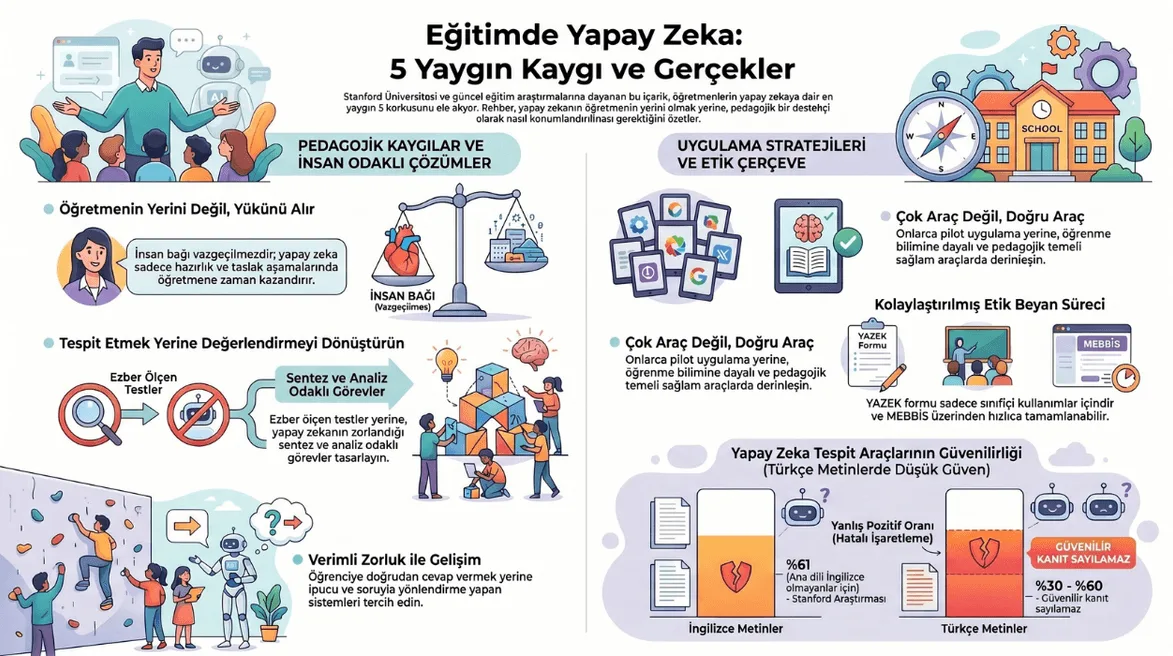
Stanford’s answer is clear: in an increasingly digital world, human connection is becoming even more indispensable. The classroom is more valuable than ever for human relationships and peer community.
Research from Türkiye published in PNAS makes this concrete. Pupils who studied with an AI that handed them answers directly ended up behind those who studied with the textbook in the exam. The difference emerged in the pedagogical knowledge behind the system. The person who builds that knowledge is the teacher. AI can generate questions, prepare drafts and offer ideas. But it does not replace the teacher who senses which pupil is stuck where and who builds trust with them. AI takes on the teacher’s preparation load, not the teacher.
Worry 2: “Pupils will cheat, and I won’t be able to tell”
This worry has two layers.
The first is the detection reflex. Most teachers turn to an AI detection tool, yet these tools are not reliable in Turkish. According to a study by Stanford researchers, these tools wrongly flag the writing of non-native English speakers as “AI-generated” 61 per cent of the time on average. In Turkish, the false positive rate climbs into the 30-60 per cent band. A score, on its own, is not evidence.
The second, and the one that really matters, is the solution Stanford proposes: rather than chasing detection, rethink assessment. The era of tests that measure memorised knowledge is closing. Synthesis, analysis and multi-stage tasks are the areas AI cannot manage on its own. As the ETS executive put it, assessment must stop being something done only at the end of the process. The real answer to “will pupils cheat” lies in designing tasks that cannot be cheated on.
Worry 3: “AI will dull pupils’ thinking and creativity”
Stanford treats this as a myth in its own right. AI does not kill creativity, but without deliberate design it can dull it. A study carried out in secondary schools in Brazil showed that AI help worked on immediate tasks, but that performance dropped markedly once the AI was taken away.
The PNAS research from Türkiye and the concept of “cognitive debt” point in the same direction. The gains of a pupil who receives ready-made answers all but evaporate once the AI is removed. But the right design turns the picture around. Pupils working with a system that offers hints and asks questions instead of giving answers keep what they have learned. Learning science calls this “desirable difficulty”. The dulling is not in the tool; it is in letting the tool do the thinking in the pupil’s place.
Worry 4: “The more AI tools I use, the better”
This is perhaps Stanford’s least expected finding. Building an AI tool is easy; building an effective one grounded in learning science is hard. There are plenty of pilots out there, but few applications with proven impact.
As Susanna Loeb summed it up, if you are going to offer a programme to thousands of schools, you need to set it up in a way you can learn something from. The right question for a teacher is not “how many tools am I using” but “does the tool I use actually work”. Rather than getting lost among ten different apps, going deep with a single tool on solid pedagogical foundations gets more done.
Worry 5: “All these rules and declarations are too much of a burden”
YAZEK and the Ethical Declaration Form look complicated at first glance, but in practice the system is simple. The form is completed with your MEBBİS sign-in, it is not long, and you do not wait for a separate approval. What is more, not every use of AI requires a declaration.
If you will be using AI with pupils in the classroom, the form applies. If you are using AI at home to prepare a lesson plan, it does not. Once you have learned the distinction, the process comes down to a matter of minutes.
Where does Madlen sit among these worries?
Madlen was built with a design that takes these five worries into account from the start. Every output passes through teacher review, and no tool ever gives a pupil a mark directly (Worry 1). The question generation and assessment tools build tasks that measure synthesis and analysis rather than memorisation (Worry 2). Madlen Okul does not hand out answers; it steers pupils towards thinking (Worry 3). More than fifty-six tools work as an integrated whole on a single learning science foundation, rather than as scattered pilots (Worry 4). All tools are aligned with MoNE’s curricula, and therefore with the ethical framework, and data is stored within the borders of the European Union (Worry 5).
When set up properly, artificial intelligence takes on the teacher’s workload, not their peace of mind.
Sources
-
Stanford Accelerator for Learning (2026). Five Myths About AI and Education. https://acceleratelearning.stanford.edu/story/five-myths-about-ai-and-education/
-
Bastani, H. et al. (2025). Generative AI without guardrails can harm learning. PNAS, 122(26).
-
Liang, W. et al. (2023). GPT detectors are biased against non-native English writers. Patterns, Cell Press.
-
Ministry of National Education (2026). Guide to the Ethics of Artificial Intelligence Applications in Education.