
What Is a Context-Based Question? How to Write TYMM-Aligned Questions

A teacher is preparing questions for an exam. Out of old habit, they write “Which of the following is a greenhouse gas?” Then they add a short paragraph about global warming above it. The question looks “modern”, but there is a problem: even without reading the paragraph, a pupil who knows the definition of a greenhouse gas will find the correct answer. In other words, the text serves no purpose at all.
With the Türkiye Century Education Model (TYMM), this is a structure the Ministry no longer accepts. In March 2026, the Board of Education and Discipline published the “Türkiye Century Education Model Guide to Writing Context-Based Multiple-Choice Questions”. It runs to 123 pages, edited by Prof. Dr. Nuri Doğan of Hacettepe University, and is published by the Ministry of National Education (MoNE) Directorate General for Measurement, Assessment and Examination Services.
In this post we summarise the guide’s framework and how teachers can apply it in the classroom.
What is a context-based question?
The guide’s definition is clear: a context-based question requires the pupil to encounter a meaningful context, such as a text, a problem situation, a data set, an image or a scenario, and to use that context to make a decision, offer an interpretation, produce a solution or provide an explanation.
Two important points:
It is not a question type; it is a design approach. A context-based question does not have to be multiple choice. It can also be constructed in extended-response, true-false or open-ended formats. What matters is not the format but how the question is structured.
It is not a new concept. International assessments such as PISA and TIMSS have used this approach for decades. The concept’s roots go back to the 1940s and 1950s. What is new for Türkiye is that the national curriculum has placed this approach at its centre.
Why does it matter so much?
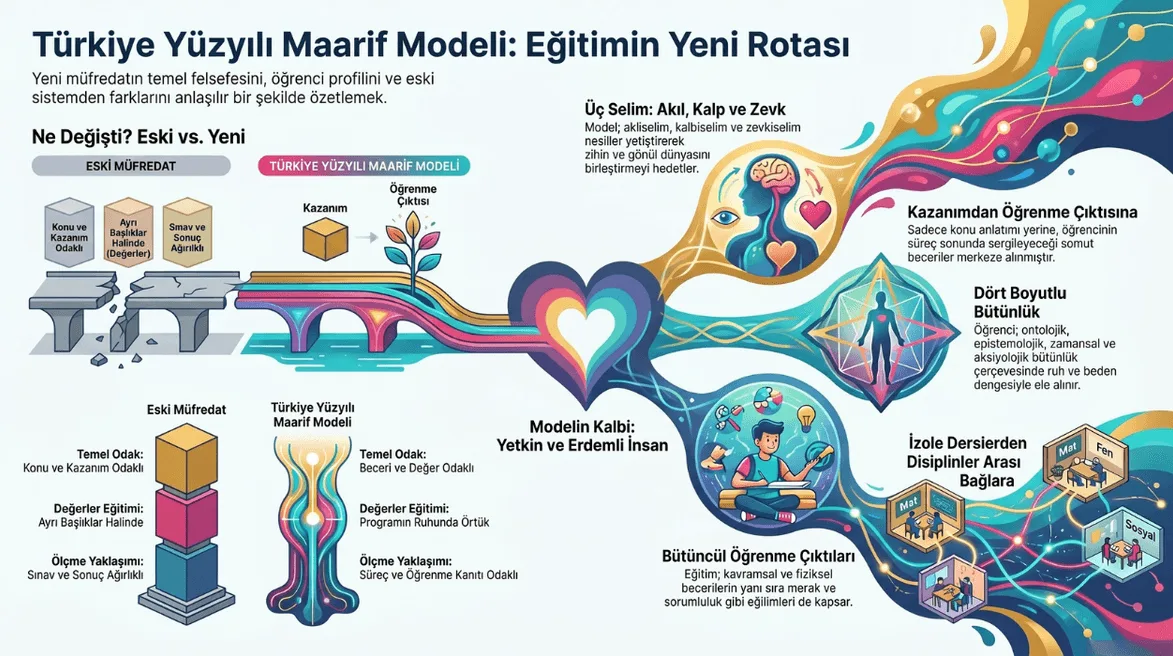
Because TYMM asks “what can the pupil do with what they know” rather than “what does the pupil know”, the assessment system needs to be redesigned accordingly. Old-style “learning outcome questions” only measure recall. TYMM, by contrast, wants to measure skills such as problem solving, inquiry and critical thinking. And it is practically impossible to measure these skills outside a context.
The guide makes this emphasis: context-based questions serve as evidence of skill, showing that pupils can demonstrate their cognitive and social skills in everyday life.
The five stages of writing a context-based question
The MoNE guide recommends structuring the process in five steps:
Step | What is done |
1 | Clarifying the goal: identifying the learning outcome and process component to be measured |
2 | Building a context connected to everyday life |
3 | Preparing questions that aim to measure the relevant process components |
4 | Constructing strong distractors |
5 | Testing whether the context is functional (can the question be solved without the context?) |
The fifth step is critical. If the question can be solved without the context, the context is not doing its job, and the process must be repeated from the beginning.
Common mistakes
One of the guide’s most practical sections explains the common mistakes in question writing through concrete side-by-side examples. There are four main categories:
1. Context mistakes
Wrong: A text about global warming followed by the question “Which of the following is a greenhouse gas?” The text is redundant, and the question is context-free.
Right: Presenting a graph or data in the context, so the question can only be answered by examining and interpreting that data.
2. Question stem mistakes
Wrong: Phrasings with double negatives, such as “Which of the following cannot be said not to be…?” A structure that tires the mind unnecessarily and leads to measurement error.
Right: If there is a negative, it should be single and clear, and set in bold: ”… is not?”
3. Option and distractor mistakes
Wrong: Using options such as “All of the above”, “None of the above” or “A and B”. Once a pupil is sure one option is correct, they can find the answer without analysing the others.
Right: Each option should contain an independent proposition. Distractors should be drawn not from random errors but from the scientific misconceptions a pupil who has “learned the topic incompletely” or “constructed it incorrectly” would fall into.
4. Design and typesetting mistakes
Wrong: Images that merely illustrate what the text already says. Data labels that are far too small, needlessly three-dimensional charts. The text on one page and the question on another.
Right: The image should present new data rather than repeat the text. Two-dimensional, simplified, clearly labelled charts. The context and the question sharing the same visual space.
How to test a context-based question
The guide’s most pragmatic piece of advice is this: delete the context from the question you have written and have someone read only the question stem. Can the question still be answered?
-
Yes, it can: Your context is not functional. Start the process again.
-
No, it cannot: The context is functional, and the question genuinely measures a skill.
This test is the quickest way to weed out “modern-looking but old-style” questions early on.
How many questions does a teacher need to write per week?
TYMM is based on recommending at least one assessment instrument for every learning outcome and setting at least one performance task for every unit. Depending on their subject, a teacher has to produce an average of 15-30 new questions a week. Putting each one through the five-stage process, constructing the context, designing the distractors and running the functionality test adds up to serious time.
How does Madlen generate TYMM context-based questions?
Madlen’s Question Generation tool works by directly referencing the context-based question writing principles in the MoNE March 2026 guide. When a teacher selects their subject, year group and target learning outcome, the system:
-
automatically links the relevant learning outcome and process components in the TYMM curriculum,
-
builds a context connected to everyday life, not classroom-specific and not artificial,
-
generates more than one question from the context,
-
bases distractors on misconceptions rather than “random errors”,
-
and finally runs the test of whether each question can be solved without the context.
Questions that fail the functionality test do not enter the pool. In other words, the guide’s fifth-stage check, “can the question be solved without the context?”, is completed within the process.
Madlen also filters out the flawed patterns. Double negatives, “All/None of the above” options, a correct answer that is conspicuously longer than the others, images that simply repeat the text. These patterns are never generated.
As a result, instead of writing a context-based question from scratch, the teacher reviews the questions the system produces and adapts them to their own class. A 30-40 minute question writing process comes down to 2-3 minutes.
Sources:
-
Millî Eğitim Bakanlığı (2026). Türkiye Yüzyılı Maarif Modeli Bağlam Temelli Çoktan Seçmeli Soru Yazım Kılavuzu. Ölçme Değerlendirme ve Sınav Hizmetleri Genel Müdürlüğü, Ankara. ISBN: 978-975-11-9562-3.
-
Doğan, N. (Ed.) (2026). TYMM Bağlam Temelli Çoktan Seçmeli Soru Yazım Kılavuzu. Hacettepe Üniversitesi.
-
Haladyna, T. M. (1992). Context-dependent item sets. Educational Measurement: Issues and Practice.
-
Ahmed, A. & Pollitt, A. (2007). Improving the quality of contextualized questions. Assessment in Education.