
What Is MoNE's Artificial Intelligence Applications Ethics Board Directive?

22 October 2025. The Board of Education published a document that, for the first time, brought the use of artificial intelligence in education under a single official framework: the Artificial Intelligence Applications Ethics Board Directive. The directive defines the entire chain of oversight, from a teacher’s use of AI in the classroom to a decision taken at the centre of the Ministry of National Education (MoNE).
So what exactly does this directive regulate? In this post we break down the structure it establishes, its ethical principles, and the process that kicks in when a violation occurs, in plain terms for teachers and school leaders.
What is the directive based on?
The directive rests on three legal texts: the Basic Law of National Education No. 1739, Law No. 6698 on the Protection of Personal Data, and the Presidential Decree on the Organisation of the Presidency. In other words, it is not a rule dropped out of thin air, but an extension of existing education and data protection legislation into the field of artificial intelligence.
Its scope is broad. All AI applications in the Ministry’s teaching, learning and administrative processes, and all users involved in those processes, fall within the directive. Everyone from a classroom teacher to a specialist at a provincial directorate is covered by this framework.
A three-tier structure
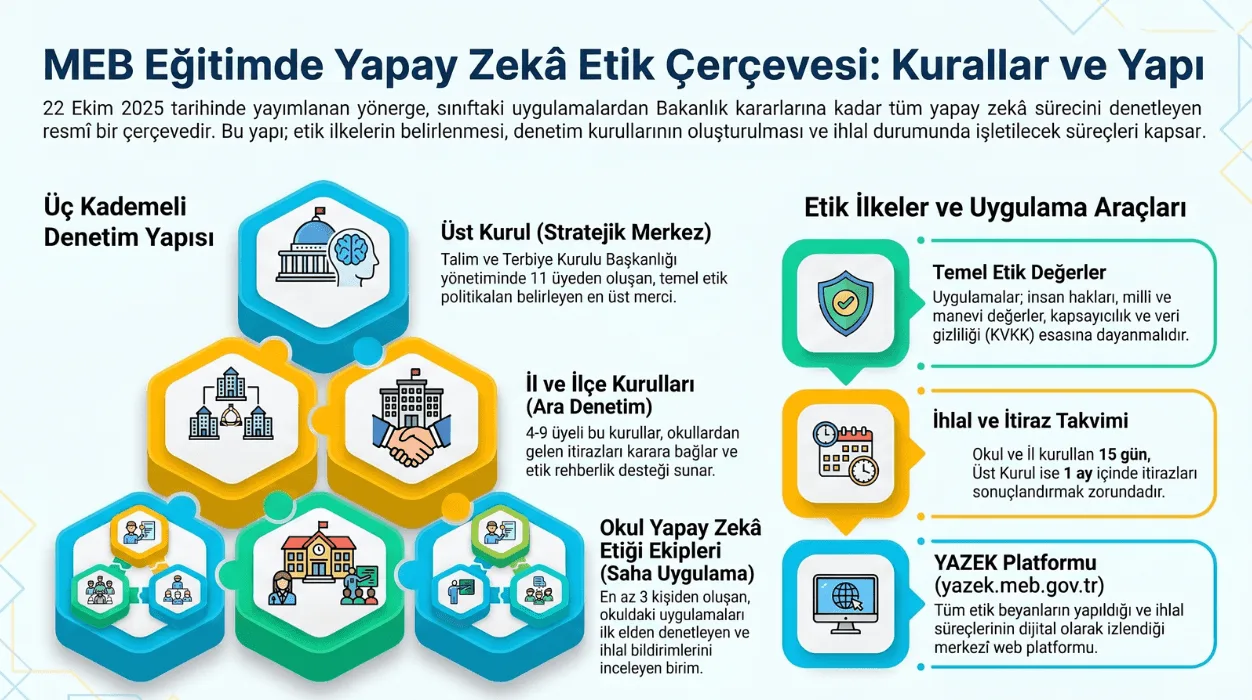
At the heart of the directive is a three-tier board structure.
The Supreme Board. Chaired by the President of the Board of Education, it has 11 members. They include representatives of Ministry units, academics, and members from the private sector and civil society. Its remit: preparing the ethical principles and the guide, following national and international developments, and ruling on appeals against the decisions of provincial and district boards.
Provincial and district boards. In every province, a board of four to nine members is established, chaired by a deputy provincial director of national education or a branch director. It includes members from the IT, strategy development and legal units. Where needed, boards with the same authority can also be set up at district level. Their remit: reviewing appeals against the decisions of school teams and supporting schools in the ethical use of artificial intelligence.
School AI ethics teams. At least three members, chaired by the headteacher. This is the first stop on the ground. The team ensures that AI applications in the school run in line with the rules, guides teachers, and acts as the first body to review reports of ethical violations. We have explained how to set up this team, step by step, in a separate post.
The ethical principles
Article 14 of the directive lists the core principles that every AI application must observe: applications that respect human rights, are grounded in national and moral values, are inclusive and accessible, comply with privacy and confidentiality requirements, are sustainable, and have open and traceable decision-making processes. Wherever personal data is involved, full compliance with Law No. 6698 on the Protection of Personal Data is mandatory.
The detail behind these principles is set out under eight headings in the Guide to the Ethics of Artificial Intelligence Applications in Education, which accompanies the directive. When a teacher completes the Ethical Declaration Form, they are in fact committing to comply with these eight principles.
The violation and appeal process
The directive is equally clear about what happens when something goes wrong. A report of an ethical violation is first made to the school:
-
The school team reviews it and reaches a decision within 15 days.
-
If there is an appeal, it goes to the provincial or district board, which also decides within 15 days.
-
The final appeal goes to the Supreme Board, which concludes the matter within one month.
An application found to be in violation is suspended. This is the clearest sign that the directive is binding rather than symbolic.
How do the directive, the guide and YAZEK fit together?
Three concepts that should not be confused:
-
The directive (22 October 2025): the framework that defines the boards, teams and processes. It answers the question “who is responsible for what”.
-
The Ethics Guide (January 2026): the reference document that explains the ethical principles and the details of the Ethical Declaration Form. It answers the question “what exactly are the rules”.
-
YAZEK (yazek.meb.gov.tr): the web platform where declarations are made and violations are tracked. It answers the question “where does all of this actually happen”.
Together, the three bring the use of artificial intelligence in education under a single traceable system.
Madlen and this framework
Madlen was designed to align with MoNE’s ethical framework. Data is stored within the borders of the European Union, no tool ever gives a pupil a mark directly, the learning outcome each piece of generated content is tied to is always visible, and every tool is integrated with MoNE’s curricula. So when a teacher plans an activity through Madlen and completes the Ethical Declaration Form, they are working on an infrastructure that already meets the principles they are committing to.
Sources
-
MoNE Artificial Intelligence Applications Ethics Board Directive (22 October 2025).
-
Ministry of National Education (2026). Guide to the Ethics of Artificial Intelligence Applications in Education. Board of Education, Ankara.
-
Basic Law of National Education No. 1739.
-
Law No. 6698 on the Protection of Personal Data (2016).