
What Is the Ethical Declaration Form and How Do You Fill It In?
Last lesson on a Friday. A Turkish language teacher is planning to have pupils analyse a text with a chatbot next week. Right in the middle of preparing the activity, a thought surfaces: “I think I was supposed to fill in a form for this. When exactly was it compulsory?”
Since yazek.meb.gov.tr went live in January 2026, this question has been on every teacher’s desk. Completing the Ethical Declaration Form before using artificial intelligence in the classroom is now part of the process. In this post we explain what the form is, when it is compulsory, and how to fill it in step by step.
What is the Ethical Declaration Form?
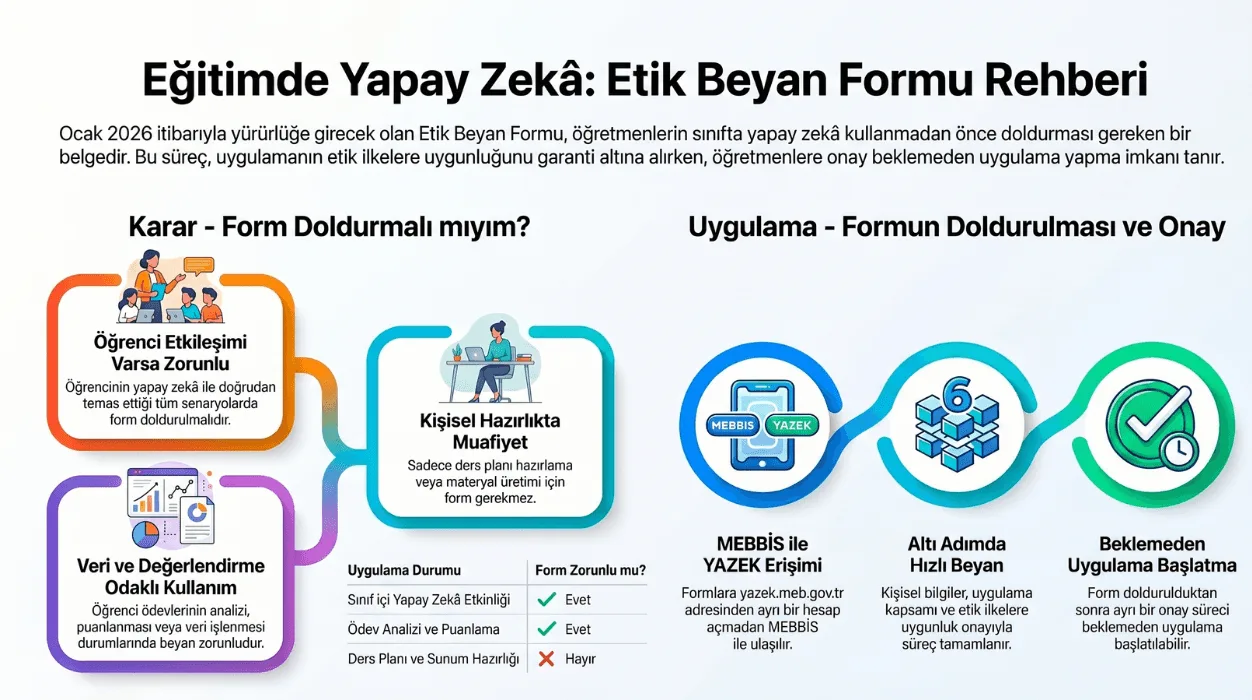
The form is the document in which a teacher declares that the AI activity they are planning complies with the ethical principles. Article 15 of the directive establishes that teachers complete this form for AI applications in educational institutions. The form is filled in on the YAZEK platform, and you sign in with your MEBBİS credentials. There is no need to create a separate account.
When is the form compulsory, and when is it not?
This is where most of the confusion lies. The guide draws a clear line: the form is compulsory in every situation where artificial intelligence comes into contact with a pupil or with pupil data.
Situations where it is compulsory:
-
Where pupils interact with AI. A pupil doing question-and-answer with a chatbot as part of a lesson, generating images or music with AI, or a lesson being taught with AI support on the interactive whiteboard.
-
Where pupil data is processed. Handing pupil work such as essays, homework or audio recordings to an AI for analysis. A declaration is required even if names have been removed.
-
Where there is assessment, marking or decision support. Using AI to score pupil work, generate feedback, or sort pupils into groups.
Situations where it is not required:
-
Lesson preparation and creating materials. Writing a lesson plan, finding activity ideas, preparing a presentation, scanning articles.
-
A pupil using AI at home on their own initiative.
In short: if you will be using AI with pupils in the classroom, the form applies. If you are using AI at home on a Sunday night to prepare a lesson plan, it does not.
Filling in the form, step by step
The form is not long. It asks for the following:
-
Personal details. Pulled in automatically from MEBBİS; you do not type them in.
-
School, year group, class, subject. You choose these from drop-down lists.
-
Scope of the activity. What is the purpose: assessment and marking, content creation, or question-and-answer?
-
The AI tool. Which tool you will use. If it is not on the list, you choose “other” and type it in.
-
Description. You briefly explain how the activity will run.
-
Declaration of compliance with the ethical principles. You confirm that the activity complies with the eight ethical principles.
The form can be saved as a draft. Once submitted, it stays open for editing for 3 days, then it is locked.
What happens after you submit it?
The good news: there is no separate approval process. You can fill in the form and start your activity straight away. You do not have to wait.
There is one exception: if the School AI Ethics Team spots an obvious risk in the declared activity (for example, data collection that breaches Turkish data protection law), it can send you a warning not to start, or to stop, the activity, and open a review.
A short checklist before using AI
Before filling in the form, get clear on the following:
-
In this activity, are pupils interacting with the AI, or am I the only one using it? If the answer is “pupils”, the form applies.
-
Which tool will I use, and where does it store pupil data?
-
Is the pedagogical purpose of the activity clear, or is the AI there just for the sake of having used it?
-
Have I explained to pupils how to use the AI, and that the final piece of work must be their own?
That last point matters. We have written before about how AI detection tools are not reliable in Turkish. Setting the rule up front is far healthier than a “did you really write this” argument later.
How does the declaration work when using Madlen?
If a teacher is planning a pupil-facing activity through Madlen, it is still the teacher who completes the Ethical Declaration Form. The guide defines the declaration as a teacher’s responsibility, and that responsibility cannot be delegated to a platform.
Where Madlen makes life easier is in providing an infrastructure aligned with the principles you commit to on the form. Data is stored within the borders of the European Union, every output passes through teacher review, and the learning outcome each piece of generated content is tied to is visible. So when filling in the form, you do not need to separately research the question “does this tool meet the eight principles”.
Sources
-
Ministry of National Education (2026). Guide to the Ethics of Artificial Intelligence Applications in Education. Board of Education, Ankara.
-
Artificial Intelligence Applications Ethical Declaration System (YAZEK), yazek.meb.gov.tr.
-
MoNE Artificial Intelligence Applications Ethics Board Directive (22 October 2025).