AI tools for teachers

Summarize any topic with a mind map

Choose the topic, and Madlen branches it out into a map you can edit.

  • 3 to 7 main branches
  • Overview or detailed depth
  • PDF and Word downloads

A real example made with Madlen

Year 8 Science

Science • Year 8

Cells and Organisation
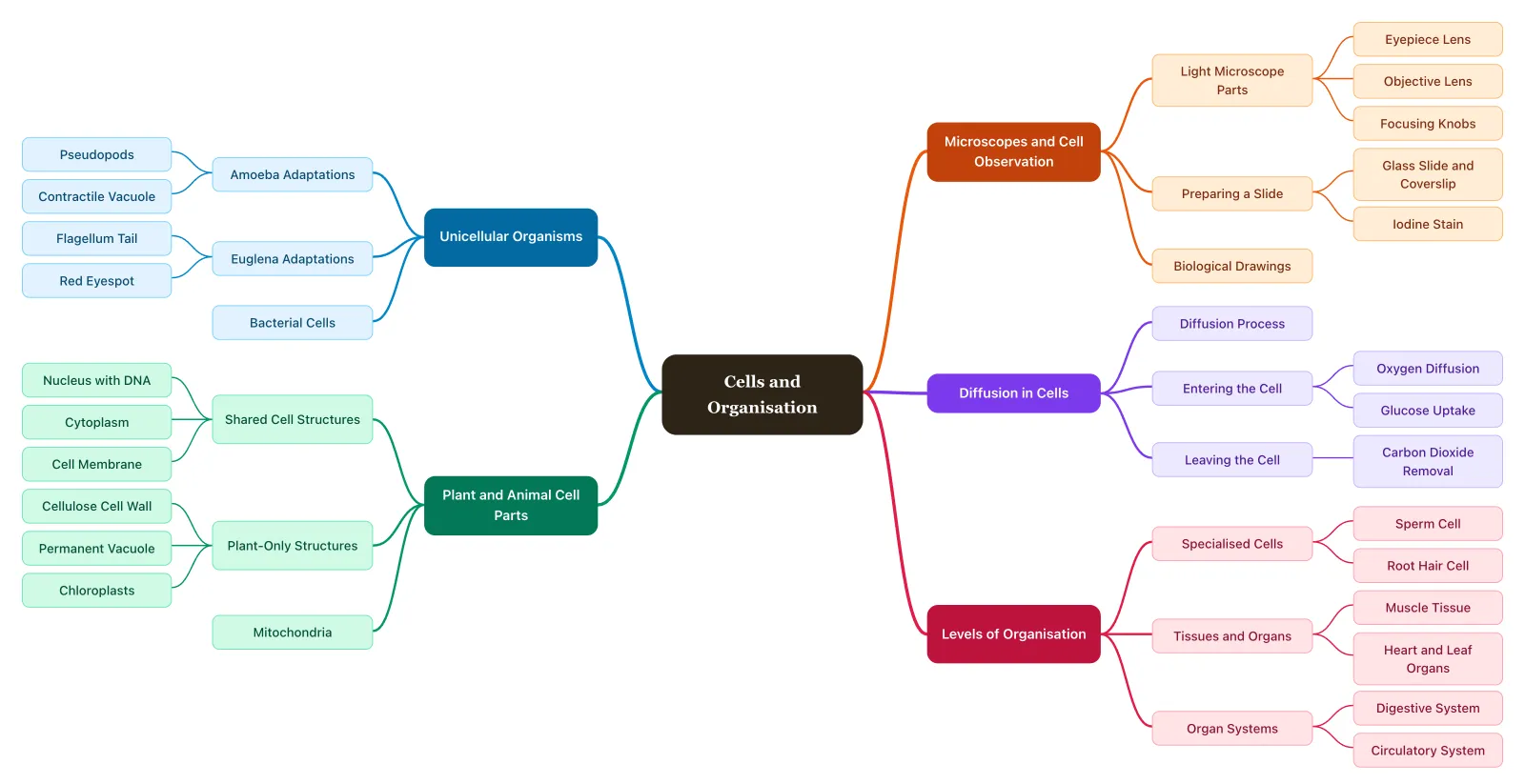
5 main branches, 44 ideas

Mind map on Cells and Organisation
  • Microscopes and Cell Observation

    We use light microscopes to view and draw cells that are too small to see with our eyes.

    • Light Microscope Parts

      The eyepiece lens and objective lenses work together to magnify the specimen.

      • Eyepiece Lens
      • Objective Lens
      • Focusing Knobs
    • Preparing a Slide

      Stains like iodine help us see clear cell parts on glass slides.

      • Glass Slide and Coverslip
      • Iodine Stain
    • Biological Drawings

      Drawings must use clear pencil lines and include labels with no shading.

  • Plant and Animal Cell Parts

    Cells contain tiny structures that carry out different jobs to keep the cell alive.

    • Shared Cell Structures

      Both plant and animal cells share several vital building blocks.

      • Nucleus with DNA
      • Cytoplasm
      • Cell Membrane
    • Plant-Only Structures

      Plant cells have three extra parts to provide support and make food.

      • Cellulose Cell Wall
      • Permanent Vacuole
      • Chloroplasts
    • Mitochondria

      These structures release energy for the cell through respiration.

  • Diffusion in Cells

    Substances move naturally in and out of cells down a concentration gradient.

    • Diffusion Process

      Particles spread out from an area of high concentration to low concentration.

    • Entering the Cell

      Useful substances like oxygen and glucose diffuse across the cell membrane.

      • Oxygen Diffusion
      • Glucose Uptake
    • Leaving the Cell

      Waste materials move out through the cell membrane so they do not build up.

      • Carbon Dioxide Removal
  • Unicellular Organisms

    Some living things are made of just one independent single cell.

    • Amoeba Adaptations

      An amoeba changes its shape to move around and engulf food particles.

      • Pseudopods
      • Contractile Vacuole
    • Euglena Adaptations

      Euglena lives in water and can make its own food using sunlight.

      • Flagellum Tail
      • Red Eyespot
    • Bacterial Cells

      Bacteria do not have a nucleus so their DNA floats freely in the cytoplasm.

  • Levels of Organisation

    Multicellular organisms are organised in a hierarchy of increasing size and complexity.

    • Specialised Cells

      Cells change their shape to perform one specific job well.

      • Sperm Cell
      • Root Hair Cell
    • Tissues and Organs

      Similar cells group into tissues, and different tissues form working organs.

      • Muscle Tissue
      • Heart and Leaf Organs
    • Organ Systems

      A group of organs works together to form a system in the whole organism.

      • Digestive System
      • Circulatory System

What you can do

A topic, branched out

Madlen splits the topic into three to seven main branches and the ideas under them. Choose an overview to open a unit or a detailed map for review. Short explanations can be added to every branch.

Yours to edit

The map opens as an editable canvas. Change branch colors and the layout, and rewrite any idea. Your changes save automatically.

A student activity from the map

Turn on the student activity and some ideas are left blank for students to fill in from a word bank. Assign it to your class and see their answers checked.

How it works

  1. 1

    Choose grade, subject and topic

    Start from a learning objective, a topic list, your own file or a short prompt.

  2. 2

    Shape the map

    Set the number of main branches and the depth, and choose explanations and the student activity.

  3. 3

    Edit and share

    Edit the map, open it on the smart board, download it as PDF or Word, or assign it.

Frequently asked questions

How do you make a mind map?

A mind map starts from one central topic and splits it into a few main branches. Each branch then splits into its own sub-ideas. Good maps keep branches distinct, use short phrases and group ideas by color. Madlen builds that structure for your topic and you edit it as you like.

What is the difference between a mind map and a concept map?

A mind map branches outward from one center and is used to summarize or review a topic. A concept map shows how concepts relate to each other with arrows and linking phrases. Madlen’s Mind Map uses the branching structure.

How can I use mind maps in class?

An overview map shows the whole topic at the start of a unit. A detailed map works for review before a test. With the student activity, the same map becomes a review task where students fill the blanks from a word bank.

What formats can I download?

Download the map on its own or the map with explanations, as PDF or Word. You can also open it on the smart board.

How do I get started with Madlen?

Sign in at teacher.madlen.io with your Google account to start on Madlen’s free plan. Schools that want institutional features can begin with a 14-day pilot.

Try Madlen with your own class

Create a free account and start with the tools you need today.

Start free