Does AI Make Pupils Lazy? What Does the Research Say?

There is a sentence you hear a lot in the staff room: “The kids don’t think any more, they ask AI for everything.” Is the worry real, or is it the classic reaction every new technology gets?
The answer sits somewhere in between. Research shows that AI used without pedagogical guidance really can harm learning. But the same research also shows that a well-designed AI can do the exact opposite. The issue is not the tool, but how it is used.
The short answer: what matters is not the tool, but the use
The OECD’s Digital Education Outlook report, published in January 2026, puts it plainly. AI can support learning, but only when it is guided by clear pedagogical principles. Used without pedagogical guidance, it raises task performance without producing genuine learning gains.
This distinction matters. The pupil finishes their homework faster and looks good in the moment, but has not actually learnt. According to the same report, 31 per cent of pupils in Europe get direct solutions to their tasks from AI. So the feeling in the classroom that “the child asks AI for everything” is not unfounded.
The thing called “pedagogical debt”
A concept discussed by Genio sums the situation up nicely: pedagogical debt. Choosing the easy, short-term solution with AI builds up a debt that has to be repaid later. The pupil reaches the answer but never walks the path of thinking that leads to it, and the muscles of higher-order thinking never develop.
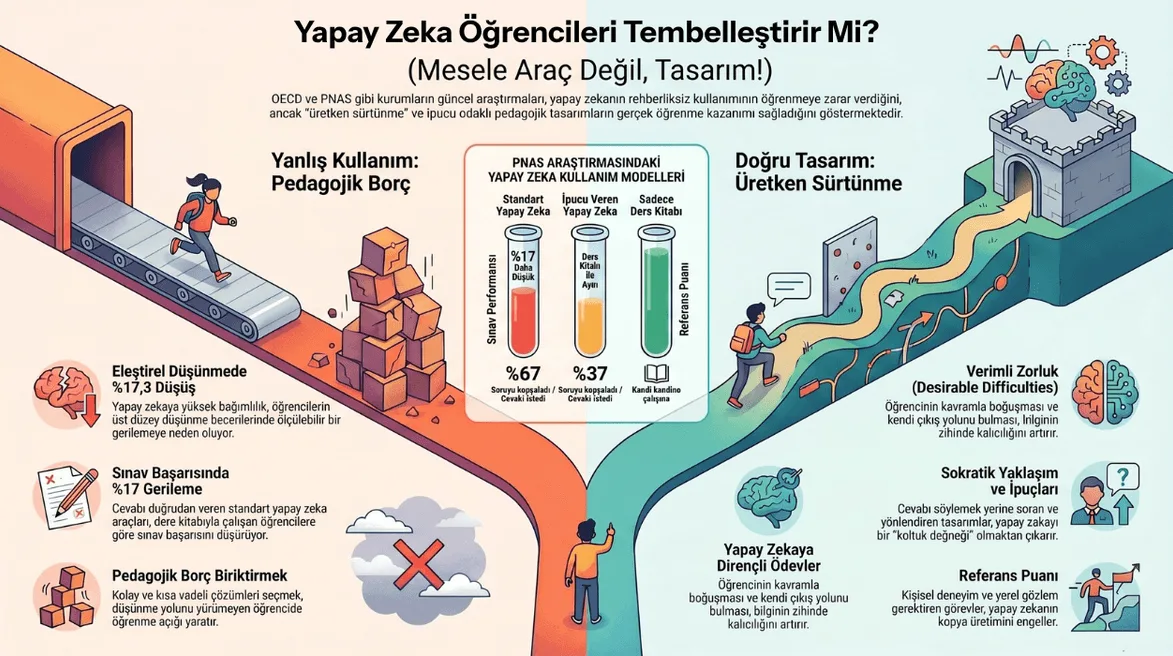
There are numbers too. High dependence on AI is associated with a 17.3 per cent drop in critical thinking scores compared with low-frequency users. That is the measurable counterpart of the “it makes them lazy” intuition.
Evidence from Türkiye: the crutch effect
A study of around a thousand secondary school pupils in Türkiye, published in PNAS, showed where the real dividing line lies. The pupils were split into three groups: one used a standard AI that gave the answer directly, one used an AI that withheld the answer and instead offered hints and asked questions, and one used no AI at all.
In practice, both AI groups pulled ahead. But when the exam was taken without AI, the picture changed. The standard AI group performed 17 per cent worse than the group that had studied with the textbook. The hint-giving AI group, meanwhile, matched the textbook group. In other words, with the right design, the gains made in practice carried over into the exam.
Here is the interesting part: both systems used the same AI model. The difference was not in the technology, but in the pedagogical design behind it. Of the pupils using the standard AI, 67 per cent had either copied the question in or asked it to “give the answer”. In the hint-giving group, that figure was 37 per cent.
The solution: protecting productive friction
The framework Genio proposes is useful here: there are two kinds of friction. Unproductive friction is the mechanical, repetitive work. AI can comfortably take that over. Productive friction is the difficulty that learning requires. That must be protected. A good educator acts like a “friction architect” who can tell the two apart.
Learning science calls this necessary struggle “desirable difficulties”. When a pupil genuinely wrestles with a concept, takes a wrong turn and finds their own way out of it, the knowledge leaves a deeper trace in the mind. A hint-giving AI protects exactly this difficulty: instead of giving the answer, it asks, points the way and waits.
The OECD report arrives at the same place. AI can be effective in three roles in education: tutor, partner and assistant. But because general-purpose tools were not designed for learning, education systems need to encourage tools built to improve learning.
What can the teacher do?
The question is not “should we ban AI”. A few practical approaches change the game:
-
Set AI-resistant homework. Tasks that require local observation, personal experience and real-world interaction cannot easily be produced by AI.
-
Make the process visible. Track whether the pupil pasted the text in one go or built it up over time.
-
Regulate AI rather than banning it. A policy that says “you may use it at this stage, for this purpose, but the final product must be yours” is healthier than covert use.
How does Madlen build this design?
When a pupil asks a question in Madlen School, the system never gives the answer. It asks, it guides, and it waits for the pupil to find the next step themselves. This Socratic approach is exactly the “hint-giving AI” design from the PNAS study, which means it protects productive friction.
Madlen’s AI Resistant Homework tool exists for the same reason. The teacher selects the curriculum, the learning outcome and the year group, and the system generates homework ideas the pupil will complete through their own thinking process. As the OECD points out, integrating teacher expertise into AI design produces a result that neither the teacher nor the AI could reach alone. The upper levels of Bloom’s taxonomy, namely analysing, evaluating and creating, are left to the pupil.
AI does not make pupils lazy. AI used without pedagogical guidance does. Well-designed AI does the exact opposite: it pushes pupils to think more.
Sources
-
Bastani, H. et al. (2025). Generative AI without guardrails can harm learning: Evidence from high school mathematics. PNAS, 122(26), e2422633122.
-
Genio (2026). The Pedagogical Debt of AI: Why the Best Educators Are Friction Architects. https://genio.co/blog/pedagogical-debt-ai-best-educators-friction-architects
-
OECD (2026). Digital Education Outlook 2026: Exploring Effective Uses of Generative AI in Education. https://www.oecd.org/en/publications/oecd-digital-education-outlook-2026\_062a7394-en.html