

AI tools for teachers

An AI grading tool that turns a stack of exam papers into a class report in minutes

Upload scanned papers and Madlen grades each question, with per-student scores and the most common errors.

  • Works from scanned exam papers
  • Common error patterns detected
  • Class report ready in minutes

A real example made with Madlen

The examples below were generated in Madlen.

GCSE Biology

GCSE Biology Exam Assessment

Mock paper with fictional pupils, marked by Madlen against the teacher's mark scheme.
7.5/10Class average
2Papers marked
Q1Hardest question
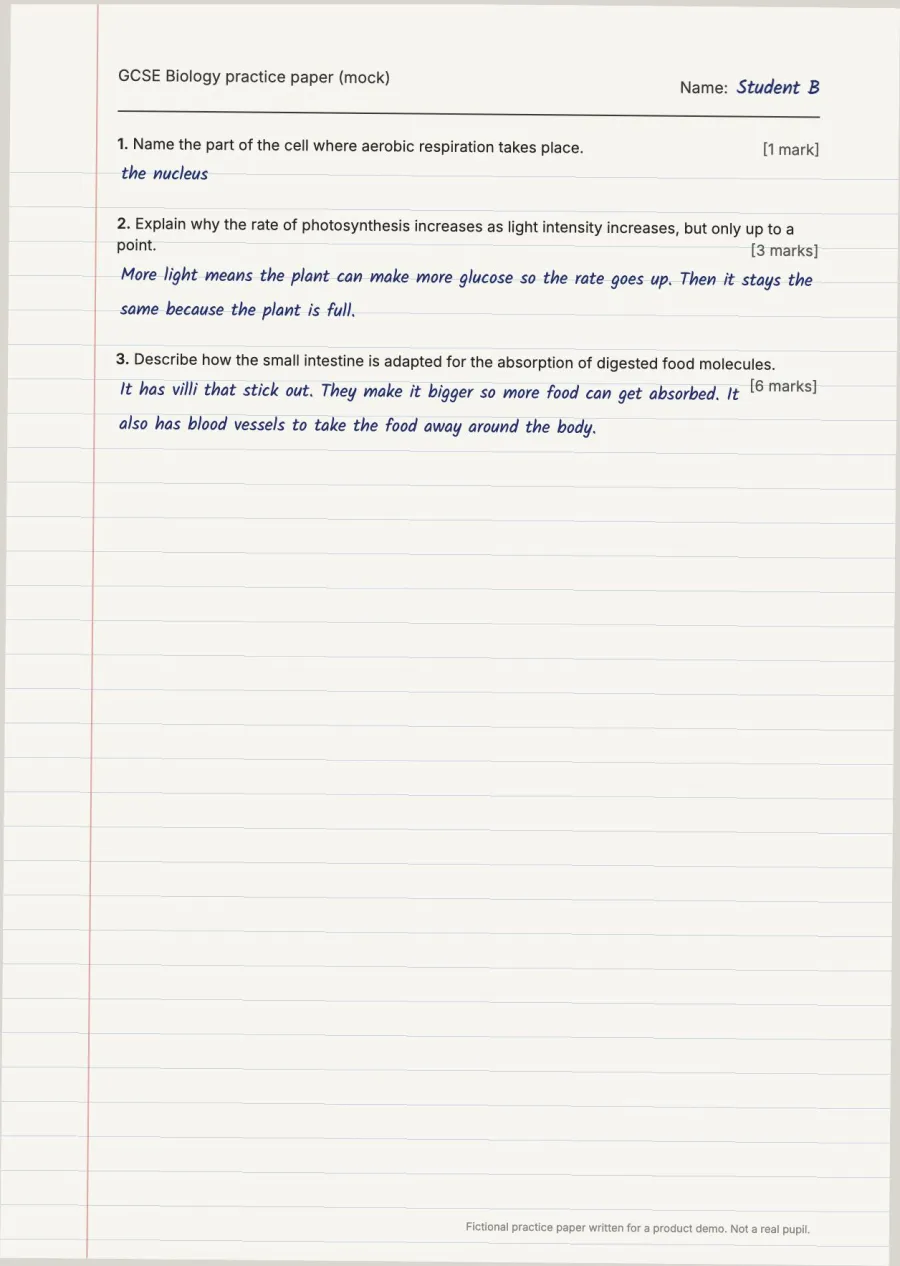
Student B, fictional mock paper
The handwritten paper Madlen read

Student B

5/10

The student shows a basic understanding of biological mechanisms, such as surface area adaptations and photosynthetic trends, but relies on informal explanations rather than precise scientific terminology. To improve, focus on key concepts such as limiting factors in photosynthesis and use precise terminology when describing organelle functions and anatomical adaptations.

  1. Question 1 0/1

    Pupil's answer the nucleus

    Incorrect organelle identified. Aerobic respiration takes place in the mitochondria, whereas the nucleus contains genetic material.

  2. Question 2 2/3

    Pupil's answer More light means the plant can make more glucose so the rate goes up. Then it stays the same because the plant is full.

    You correctly noted that increasing light increases the rate of photosynthesis. However, mention that light provides energy, and explain that the rate levels off because another factor (such as carbon dioxide concentration or temperature) becomes limiting, rather than the plant being 'full'.

  3. Question 3 3/6

    Pupil's answer It has villi that stick out. They make it bigger so more food can get absorbed. It also has blood vessels to take the food away around the body.

    This fits into Level 2. You identified villi increasing surface area and the presence of blood vessels (rich blood supply), but you should use scientific terms like 'large surface area', mention maintaining a 'concentration gradient', and include other adaptations such as thin walls for a short diffusion pathway.


Student A

10/10

The student demonstrated a comprehensive understanding of GCSE Biology topics, scoring full marks across all questions. Explanations were clear, accurate, and thoroughly linked structure to function.

  1. Question 1 1/1

    Pupil's answer mitochondria

    Correct. Mitochondria are the site of aerobic respiration.

  2. Question 2 3/3

    Pupil's answer Light gives the energy for photosynthesis so more light means the reaction goes faster. After a while it levels off because something else becomes the limiting factor, like the concentration of carbon dioxide or the temperature.

    Excellent answer. You correctly explained why light increases the rate of photosynthesis and correctly identified limiting factors such as carbon dioxide or temperature.

  3. Question 3 6/6

    Pupil's answer The small intestine is very long so there is lots of time for absorption. The inside is covered in villi which give a large surface area. Each villus has a good blood supply which keeps a steep concentration gradient so glucose diffuses in quickly. The walls are only one cell thick so the diffusion distance is short. The cells also have microvilli which make the surface area even bigger.

    Outstanding answer achieving top marks in Level 3. You clearly linked multiple structural adaptations (length, villi/microvilli, blood supply, thin walls) directly to their functional advantages in absorption.

Common mistakes across the class

  • Question 1 Incorrect organelle identified. Aerobic respiration takes place in the mitochondria, whereas the nucleus contains genetic material.
  • Question 2 You correctly noted that increasing light increases the rate of photosynthesis. However, mention that light provides energy, and explain that the rate levels off because another factor (such as carbon dioxide concentration or temperature) becomes limiting, rather than the plant being 'full'.
  • Question 3 This fits into Level 2. You identified villi increasing surface area and the presence of blood vessels (rich blood supply), but you should use scientific terms like 'large surface area', mention maintaining a 'concentration gradient', and include other adaptations such as thin walls for a short diffusion pathway.

What you can do

Scan and upload

Upload scanned or photographed exam papers and Madlen grades each student’s answers question by question.

Error patterns detected

Madlen shows where the class went wrong as well as the scores. For example, it groups students who added fractions without finding a common denominator and suggests a short recap of that step.

Criteria written for you

Madlen writes the grading criteria and levels for each question. You don’t need to build a rubric before you start.

How do you mark exam papers with AI?

Marking a stack of exam papers takes five steps in Madlen. The options below come from the form on the platform.

  1. Choose the curriculum and subject

    Pick the curriculum, the grade and the subject. You also choose the language of the report here.

    • AP
    • IGCSE
    • IB
    • A-Level
    • Common Core
    • Report language
  2. Upload the student papers

    Take photos of the handwritten papers or upload scans. You can add several files at once.

    • JPG
    • PNG
    • HEIC
    • PDF
    • Multiple files
  3. Add the answer key and instructions

    Adding an answer key is optional, and when you add one Madlen grades against it. You can also write special instructions of your own.

    • Answer key
    • Special instructions
  4. Choose the grading approach

    Pick one of five levels, from precise to supportive, and Madlen grades the papers to match.

    • Precise
    • Rigorous
    • Balanced
    • Flexible
    • Supportive
  5. Review the class report

    See the class average, the score distribution and the most common mistakes on one screen, with each student's score per question. Send feedback to students in your own words or use Madlen's suggestion.

    • Class average
    • Score distribution
    • Common mistakes
    • Student feedback

Frequently asked questions

How does AI grading work?

With Madlen you upload scanned exam papers and the AI grades each question against criteria it writes for the exam. Within minutes you get per-student scores and a class report. The report also lists the error patterns that came up most often.

What is Exam Marking in Madlen?

Exam Marking is Madlen’s AI grading tool for teachers. It grades exam papers question by question, then reports each student’s section scores, the class average, the score distribution and common error patterns.

What does the AI grading report show?

Madlen’s report shows the number of students, the class average, the score distribution and each student’s results per question. It also lists common error patterns with how many students made each one, along with a short suggestion for what to review.

Can AI grading show me what to reteach?

Yes. Madlen groups the mistakes that came up most often by question and explains each one. For example, if five students added numerators without a common denominator, the report shows it and recommends a short recap of that step.

How do I get started with Madlen?

Teachers can create a Madlen profile and start with the free plan. Schools can start with a free 14-day pilot, during which our team runs a personalized onboarding process with the school.

Try Madlen with your own class

Create a free account and start with the tools you need today.

Start free