

Real-world scenarios
Madlen sets the questions inside everyday texts such as a documentary summary, a conversation between two students or a news story. Students read the situation first and then use their knowledge to reason about it.
Madlen writes a short article, dialogue or news report, then standards-aligned questions with answers.
The examples below were generated in Madlen.
Answer questions 1.a, 1.b and 1.c according to the text below.
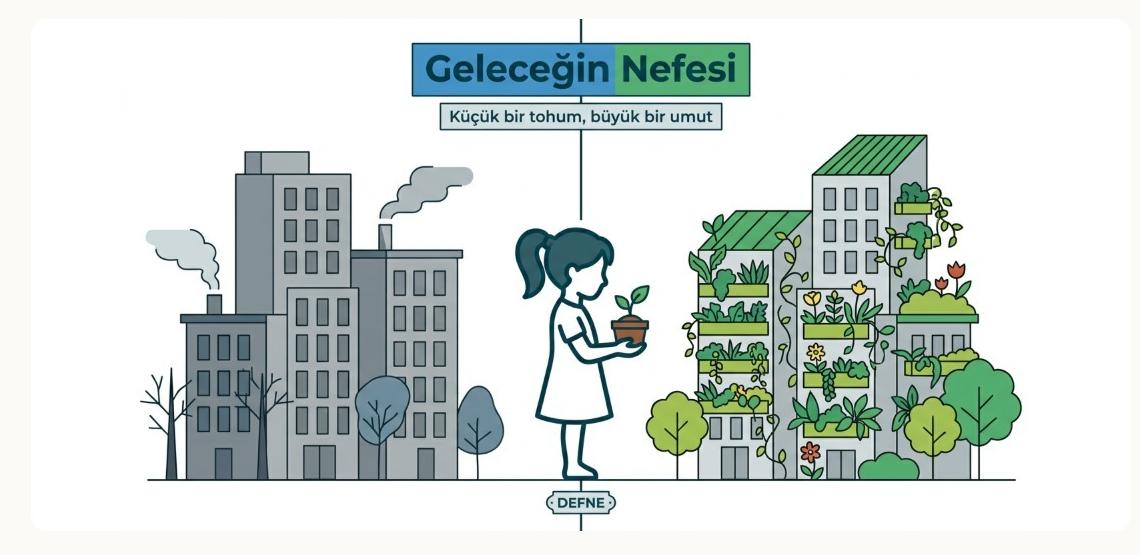
The documentary "Breath of the Future" is about the "Green Balcony" project started by eighth-grade student Defne against air pollution in her neighbourhood. It describes how Defne's journey, which started with a few potted plants on her own balcony, turned into a massive vertical garden with the support of neighbours. The director included Defne's daily notes, expert opinions, air quality measurement graphs, and before-after photos of neighbours. Defne's slogan "A small seed, a big hope" summarises the main theme. At the end, a QR code provides access to her digital diary.
Which of the following was used to increase the scientific reliability and technical depth of the information in the documentary?
Solution: Scientific data like expert opinions and air quality graphs are the key elements used to support the technical depth and reliability of the claims in the documentary. Slogans and photos provide emotional impact and visual evidence.
Based on Defne's slogan "A small seed, a big hope", what conclusion can be drawn about the project's message?
Solution: The "small seed" in the slogan represents the individual and starting small steps, while "a big hope" represents the social awareness and change that will arise from it. Therefore, the conclusion that great changes can start with small steps is most appropriate.
What was the main source chosen by the director to reflect Defne's personal experiences, feelings, and inner world during this process?
Solution: A personal diary kept by the person is the most intimate source reflecting their inner world, thoughts, and feelings. Reports and graphs provide objective data, whereas diaries reflect subjective experience.
Answer questions 2.a, 2.b and 2.c according to the text below.
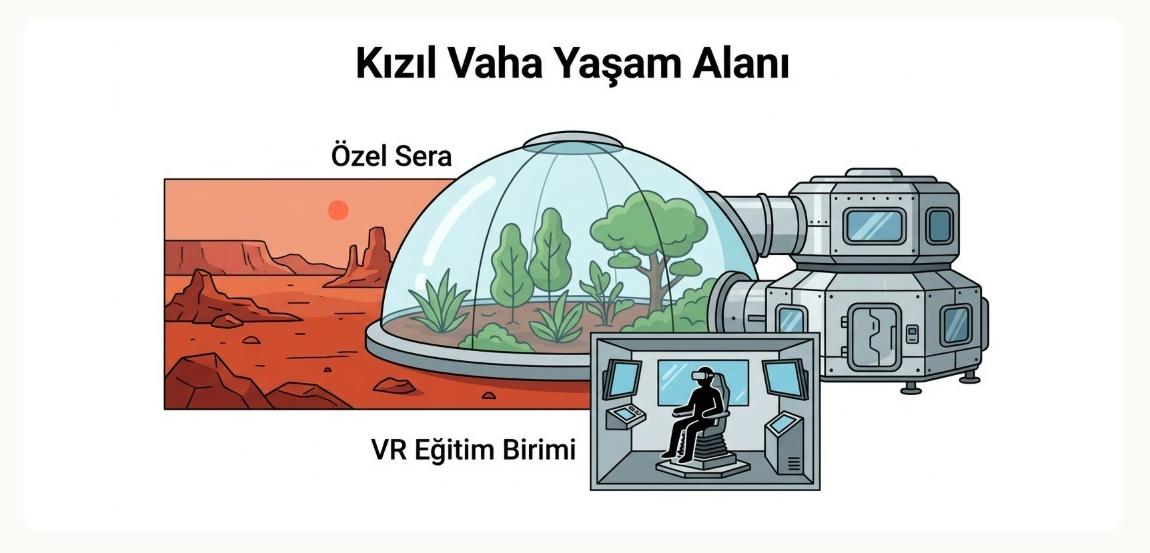
The Red Oasis Project is an international initiative aiming to establish a sustainable habitat on Mars. Seral systems and closed-loop ecosystems form the basis of the project, where plants play a vital role as both food source and oxygen producer. However, Mars' freezing cold and radiation make it mandatory to grow these plants in special greenhouses. In addition to technical infrastructure, the psychological resilience of astronauts is of great importance. Long-term isolation and confined spaces require strengthening team communication, so candidates are prepared with VR simulations.
Kerem wants to determine the summary sentence that best reflects the main idea and scope of this text. Accordingly, which of the following is the most comprehensive summary of the text?
Solution: The text describes the multi-dimensional preparations of the Mars living project, including greenhouses (biological), closed-loop systems and VR (technological), and astronaut psychology (psychological). Thus, the most comprehensive summary covers all these elements.
If Kerem wants to categorise the information as "Technological Requirements" and "Human Requirements", which matching is correct?
Solution: Closed-loop ecosystems represent a technical infrastructure and design (Technological), while the psychological resilience of astronauts refers to the human factor and mental preparation (Human).
Based on "long-term isolation and confined spaces", which of the following is expected to be a primary criterion in astronaut candidate selection?
Solution: The psychological stress of isolation and confined spaces, as well as the need for team communication, requires soft skills like managing social relations and stress management as primary criteria.
Answer questions 1.a, 1.b and 1.c according to the dialogue below.
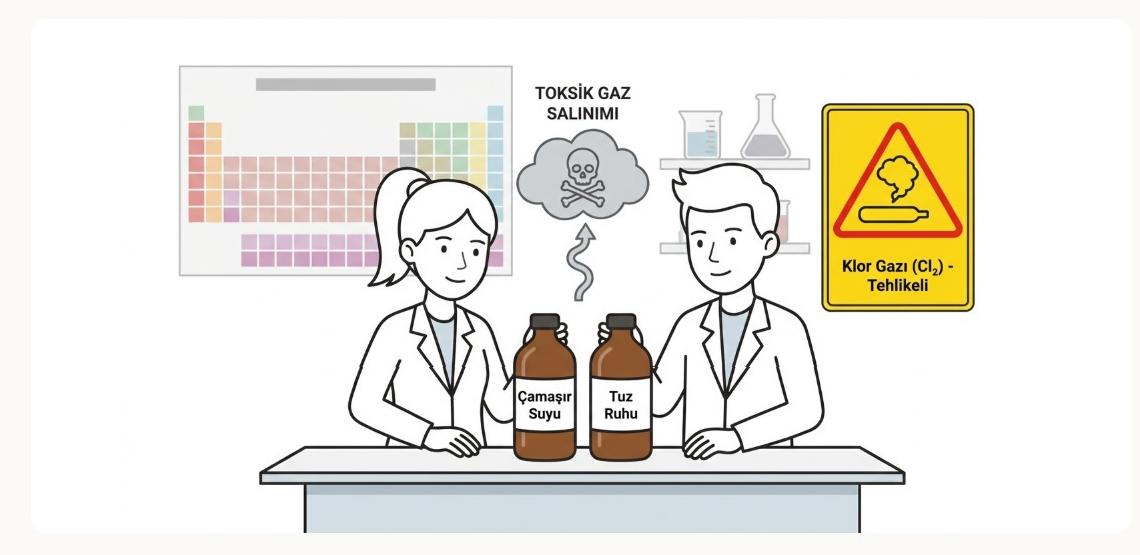
Elif: Kerem, while examining household cleaning products, I noticed that drain openers have a 'corrosive' pictogram on them, but vinegar doesn't. Why is that?
Kerem: Great observation, Elif. Drain openers usually contain strong bases like sodium hydroxide (NaOH), whereas vinegar contains acetic acid, a weak acid. These chemical differences determine their effects and safety precautions.
Elif: I read that mixing bleach and hydrochloric acid is very dangerous. Do you know why?
Kerem: Yes, when they mix, toxic chlorine gas (Cl2) is released, which can severely damage the respiratory tract. Chemistry helps us ensure safe usage by knowing the contents of these substances.
Based on the dialogue, what conclusion can be drawn about the contribution of chemistry to daily life?
Solution: Chemistry explains the chemical structures and interactions of household substances like bleach and acid, preventing dangerous gas emissions or accidents.
Considering Kerem's warning, what should be the first action if someone accidentally mixes bleach and hydrochloric acid?
Solution: Chlorine gas is highly toxic. To avoid inhaling it, windows must be opened immediately, the area ventilated, and the person should leave quickly. Closing the container can cause gas buildup and explosion.
How should the difference Elif observed between drain opener and vinegar be evaluated under chemistry's role in daily life?
Solution: Whether substances are strong bases (NaOH) or weak acids (vinegar), i.e. their pH values and molecular structures, determines their effect and usage. Chemistry explains these structures to ensure correct use.
Answer questions 2.a, 2.b and 2.c according to the news below.
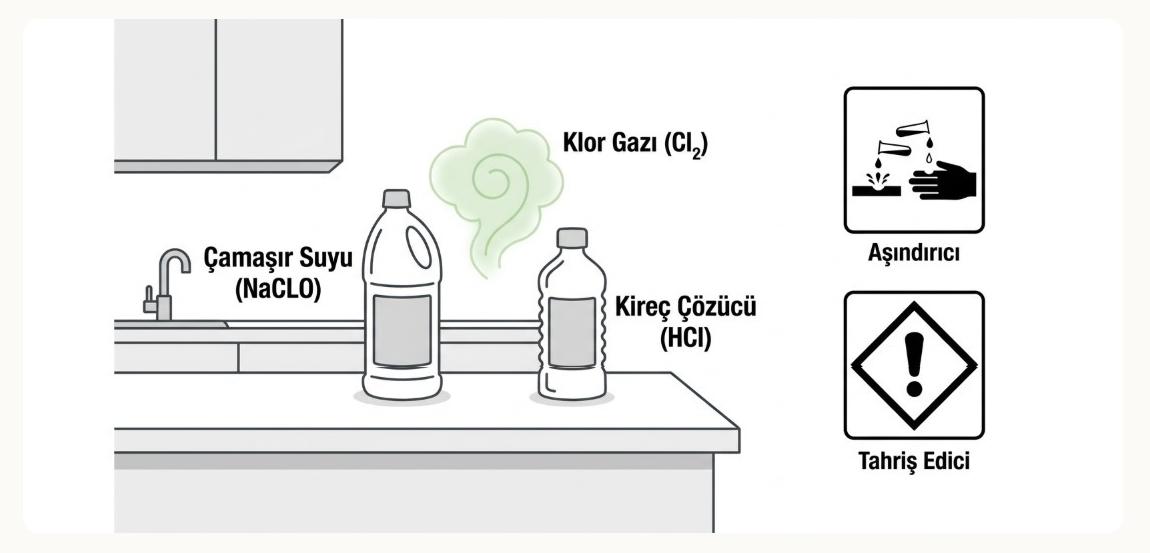
Mrs Yilmaz, who lives in Istanbul, used bleach (sodium hypochlorite - NaClO) and lime remover (hydrochloric acid - HCl) at the same time to get a better result during bathroom cleaning. Affected by the sharp-smelling, greenish gas that suddenly appeared, she was hospitalised. Doctors found she was exposed to chlorine gas (Cl2). Experts stated that mixing acidic lime removers and basic bleaches causes life-threatening reactions. They highlighted that safety pictograms are often ignored. Chemistry Engineer Can Bey stated: 'Household chemicals are produced for specific purposes. Chemistry predicts molecular interactions. This situation is a concrete result of unconscious chemical use.'
Which of the following statements about the substances and chemistry is incorrect based on the news?
Solution: As stated in the news, mixing bleach and acid is a dangerous CHEMICAL change that releases toxic chlorine gas, not a physical change, and it creates a life-threatening risk rather than increasing cleaning efficiency.
What is the most effective and comprehensive solution recommendation to prevent similar accidents?
Solution: The most fundamental and comprehensive way to prevent household chemical accidents is to read warning labels/pictograms on packaging and never mix chemicals, especially acidic and basic ones.
What is correct about the electron configuration of a ground-state chlorine atom (17Cl) forming toxic chlorine (Cl2) gas?
Solution: The ground state electron configuration of 17Cl is 1s² 2s² 2p⁶ 3s² 3p⁵. Orbitals with l=0 are "s" orbitals: 1s(2), 2s(2), and 3s(2), containing 2+2+2 = 6 electrons in total. Therefore, option B is correct.
Madlen sets the questions inside everyday texts such as a documentary summary, a conversation between two students or a news story. Students read the situation first and then use their knowledge to reason about it.
Because the answer depends on the scenario, the questions measure conceptual understanding and reasoning rather than memorized facts. That makes them a good fit for frameworks that value applying knowledge, such as IB and AP.
Each question comes with the correct answer and a short explanation of why it is right. You can edit the set, export it as PDF or DOCX, or assign it to your students.
A set of context-based questions takes four steps in Madlen. The options below come from the form on the platform.
Pick the grade level and the subject, then tick the learning outcomes you want to assess. You also choose the output language here.
Leave it on automatic and Madlen writes the context. Or start from a file of your own.
Choose how many contexts you want and how many questions each one carries. Every context has at least two questions. Then pick the format of the context.
The questions come with an answer key. Edit them, download them as PDF or Word, or assign them to your students.
Context-based questions ask students to read a scenario, such as a text, a dialogue, a data set or a news report, and use it to answer. They measure how well a student applies knowledge in an unfamiliar situation rather than what they can recall. Madlen generates these questions for you and builds the scenario as well.
In Madlen you choose the topic, the grade level and the standard, and the AI writes a real-world passage with several multiple choice questions on it. Each question comes with the correct answer and an explanation. You then review the set and adapt it to your class before using it.
Madlen creates context-based questions across subjects and grade levels. Our sample outputs include Grade 8 English questions on a documentary text and Grade 9 chemistry questions built around household cleaning products. Teachers working with IB, AP or Cambridge can select those frameworks as well.
Yes. Like all of Madlen’s questions, context-based questions are visual. A passage usually comes with an illustration that fits the scenario.
Yes. Teachers can create a Madlen profile and start using the core tools for free. Schools that want the admin panel and integrations can start with a free 14-day pilot.
Create a free account and start with the tools you need today.