
What Is YAZEK? Everything About MoNE's AI Ethical Declaration System

In January 2026, the Board of Education and Discipline published a new guide: the Ethical Guidelines for AI Applications in Education. Alongside it, a web platform went live at yazek.meb.gov.tr.
The use of AI in all schools under the Ministry of National Education (MoNE) in Türkiye is now tied to an official framework. For teachers, this means the question goes beyond “how do I use ChatGPT in the classroom”: a declaration and oversight mechanism is now part of the job.
In this article we answer the main questions on the minds of teachers and school leaders in the new process: what exactly YAZEK is, when the Ethical Declaration Form is mandatory, what happens if you do not complete it, how an ethical violation report works, and what all the stages of the process look like.
What does YAZEK mean? The acronym and the definition
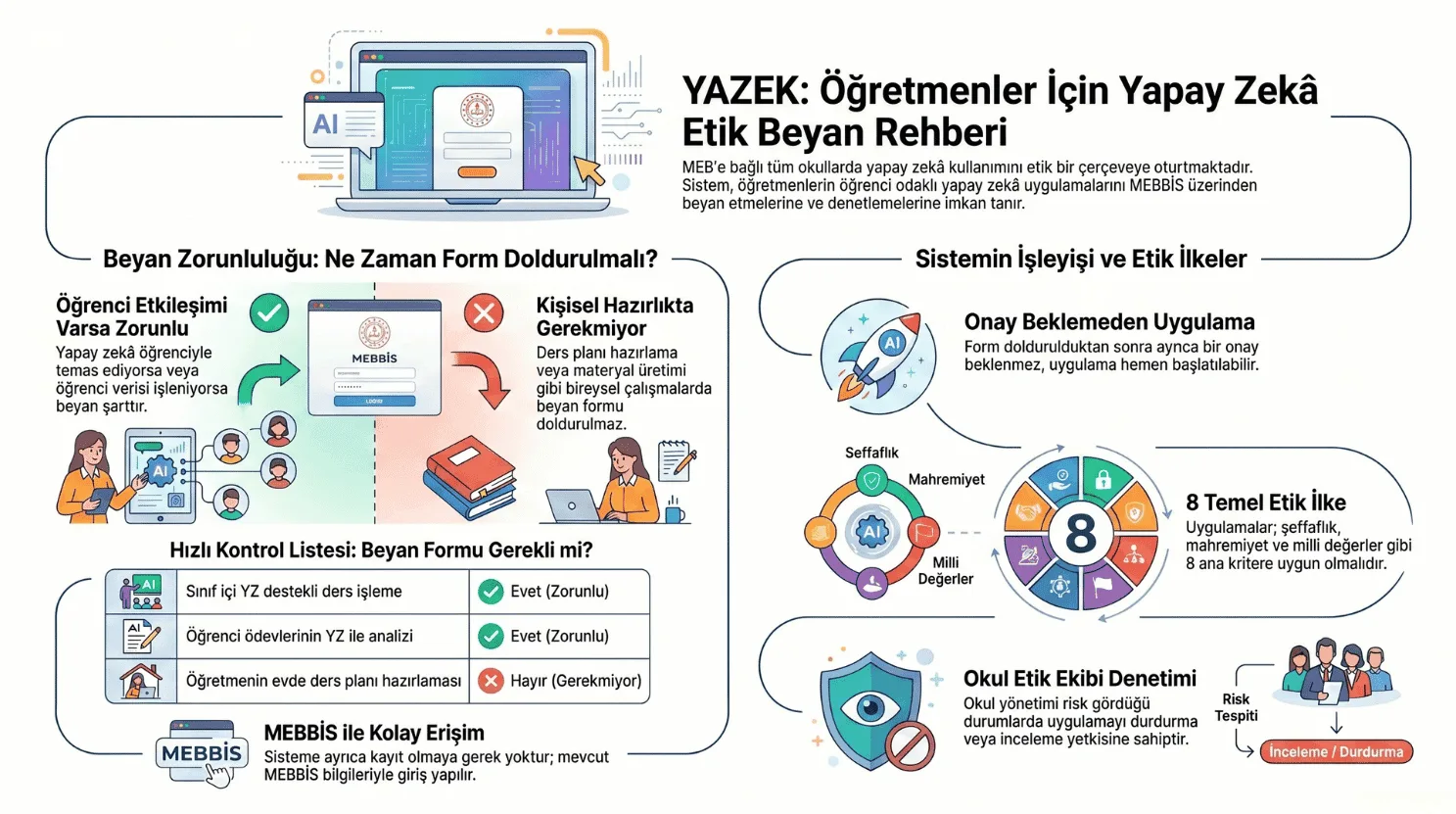
YAZEK stands for the AI Applications Ethical Declaration System (YAZEK, MoNE’s AI Applications Ethical Declaration System). It is a web-based platform developed by MoNE. The system serves three main functions:
-
It enables teachers to complete the Ethical Declaration Form for their AI applications.
-
It manages the process of receiving, examining and ruling on ethical violation reports.
-
It makes the entire ethical oversight flow, at school, provincial, district and senior board level, traceable from a single centre.
You sign in with your MEBBİS credentials. There is no need to create a separate account; your existing MEBBİS account is enough.
Which schools does YAZEK cover?
The guidelines come with a very broad scope. Under MoNE:
-
State schools of every type and level,
-
Private education institutions (private schools),
-
Science and Art Centres (BİLSEM),
-
Public education centres
all fall within YAZEK. A separate declaration process has also been defined for AI applications run by the Ministry’s central and provincial organisation units.
When must the Ethical Declaration Form be completed?
This is the part teachers find most confusing. The guidelines draw a clear line: the obligation to complete the Ethical Declaration Form kicks in whenever AI comes into contact with a pupil or with pupil data.
Situations where completing the form is MANDATORY
When pupils interact with AI. Pupils doing question-and-answer with a chatbot as part of a lesson, generating images or music with an AI tool, or the teacher running an AI-supported lesson on the interactive whiteboard. All of these count as pupil interaction and require a declaration.
When pupil data is processed. Handing pupil work such as essays, homework, audio recordings or reports to AI for analysis. Processing pupil marks or learning outcome data. Even if names are hidden and the data is anonymised, a declaration is still mandatory.
When there is assessment, evaluation or decision support. Using AI to assess or score pupil work or to generate feedback. Using AI to determine pupils’ levels or divide them into groups.
Situations where the form is NOT required
Lesson preparation, material production, professional development. Writing lesson plans, generating activity ideas, preparing presentations, scanning articles. If the teacher is using AI personally and no pupil is involved in the process, no declaration is needed.
Use on the pupil’s own initiative. A pupil using AI while studying alone at home. Since this falls outside the teacher’s direction and any official school project, it is not within the scope of the declaration.
In short: if you are going to use AI with pupils in the classroom, there is a form. If you are using AI while writing a lesson plan at home on a Sunday night, there is not.
What information does the Ethical Declaration Form ask for?
The form is not very long. Broadly, you fill in the following:
-
Personal details. Pulled automatically from the MEBBİS system, not entered manually.
-
School, year group, class, subject. Selected from drop-down lists.
-
Scope of the application. What purpose it serves (assessment and evaluation, content production, question-and-answer, and so on).
-
The AI tool. Which tool will be used. If it is not on the list, you tick “other” and write it in.
-
Description. A short account of how the application will be carried out.
-
Declaration of Compliance with the Ethical Principles. The teacher declares that the application complies with the eight ethical principles set out in the guidelines.
The form can be saved as a draft. It can be edited until it is finally confirmed. After confirmation it stays open for editing for 3 days, then it locks.
Is there an approval process after the declaration?
No. Once the form is completed, there is no separate approval process. The teacher can complete the form and start the application. This is the most practical side of the process.
There is one exception, though: if the School AI Ethics Team spots an obvious risk in the declared application (for instance, data collection that breaches KVKK, the Turkish data protection law, or a security vulnerability), it can send the teacher a “Do Not Start/Stop the Application” warning and take the case under review.
The eight ethical principles: the framework YAZEK rests on
The guidelines require AI applications to comply with eight ethical principles. They are:
-
A Human-Centred, Rights-Based Approach - Technology is a means, not an end.
-
Equality and Inclusivity - No discrimination against any group.
-
Transparency and Explainability - Users must know they are interacting with AI.
-
Privacy, Confidentiality and Data Governance - Full compliance with KVKK.
-
Reliability, Safety and Technical Robustness - Protection against hallucinations and security threats.
-
Accountability and Human Oversight - Final responsibility always rests with a human.
-
Educational Value and Meaningful Contribution - It must serve a pedagogical purpose.
-
Alignment with National and Moral Values - Content consistent with Law No. 1739.
These eight principles are not independent of one another; they form a holistic framework. When a teacher completes the Ethical Declaration Form, they are in fact making a commitment to comply with all eight.
Madlen and YAZEK alignment
Madlen was developed with a design that embraced MoNE’s ethical framework from the start. If a teacher’s use of the platform counts as an application that requires the Ethical Declaration Form, that declaration is made by the teacher, not by us (the guidelines define it as a teacher responsibility in any case).
The ways Madlen’s infrastructure lines up with the ethical principles:
-
Data governance: Compliant with KVKK and the GDPR. Thanks to the Infercom partnership, data is stored within EU borders, in Germany.
-
Human oversight: No Madlen tool ever gives a pupil a mark directly. Every output passes through the teacher’s review.
-
Transparency: What Madlen Assistant produces, and which learning outcome it connects to, is always visible.
-
Educational value: All tools are directly integrated with MoNE curricula. TYMM alignment is built in at infrastructure level.
-
Alignment with national values: Content production observes Turkish-language and cultural sensitivity consistent with Law No. 1739.
So when a teacher plans an application through Madlen and completes the Ethical Declaration Form, they are working on an infrastructure that matches the principles they have committed to in the form.
Sources:
-
Ministry of National Education (2026). Ethical Guidelines for AI Applications in Education. Board of Education and Discipline, Ankara.
-
MoNE Directive on the AI Applications Ethics Committee (22 October 2025).