
Bloom's Taxonomy and the Limits of AI

In today’s world, surrounded on every side by AI tools, asking your pupils to analyse something, weigh up different perspectives and produce their own interpretation is becoming harder and harder.
Bloom’s Taxonomy, as revised by Anderson and Krathwohl in 2001, defines cognitive learning as a six-level hierarchy: remembering, understanding, applying, analysing, evaluating and creating. This hierarchy is not merely a theoretical framework; it is a map of what a well-designed teaching process is actually aiming for. The lower levels form the ground for the upper ones, and truly deep learning depends on the pupil climbing those steps through their own mental effort.
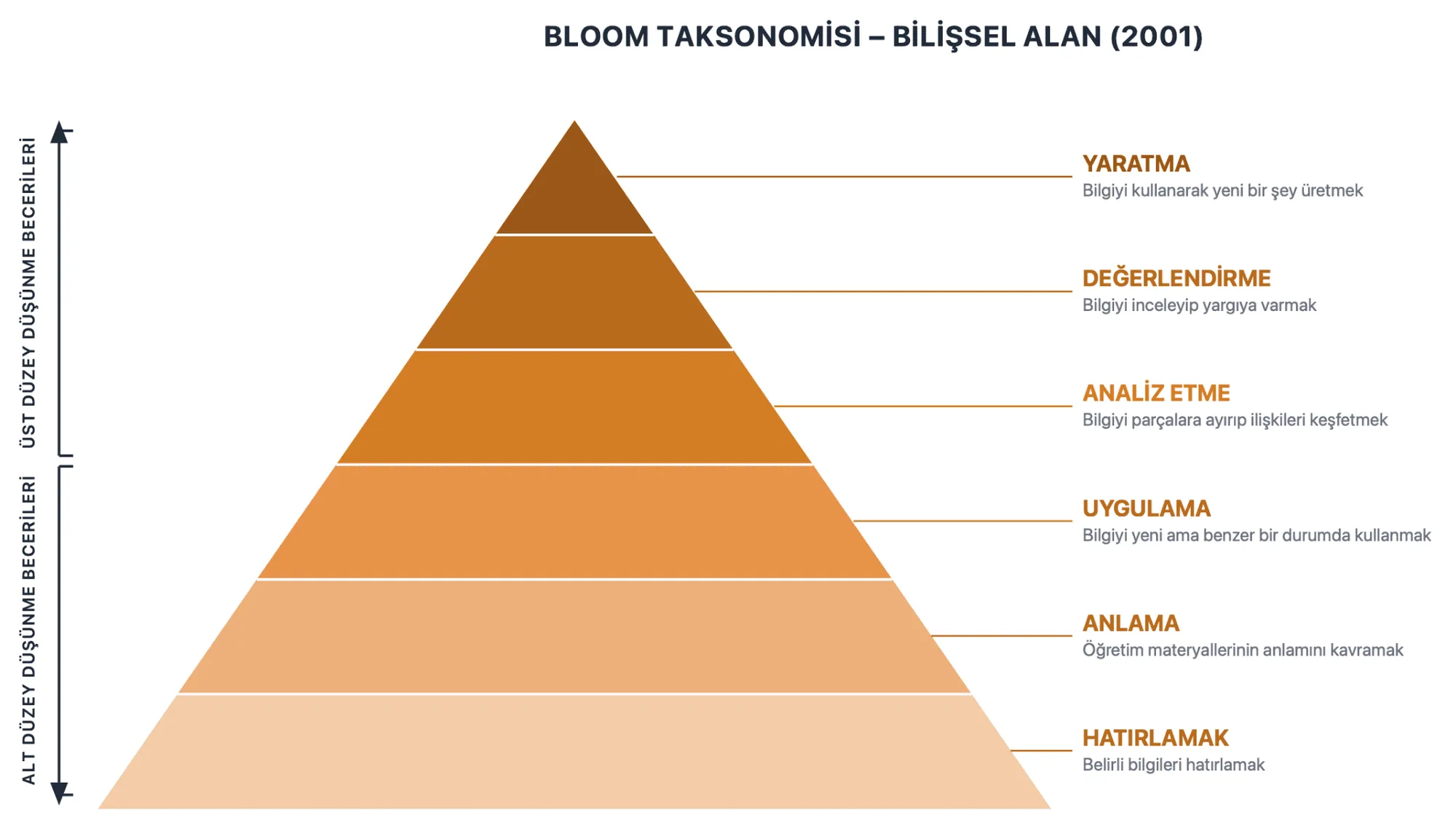
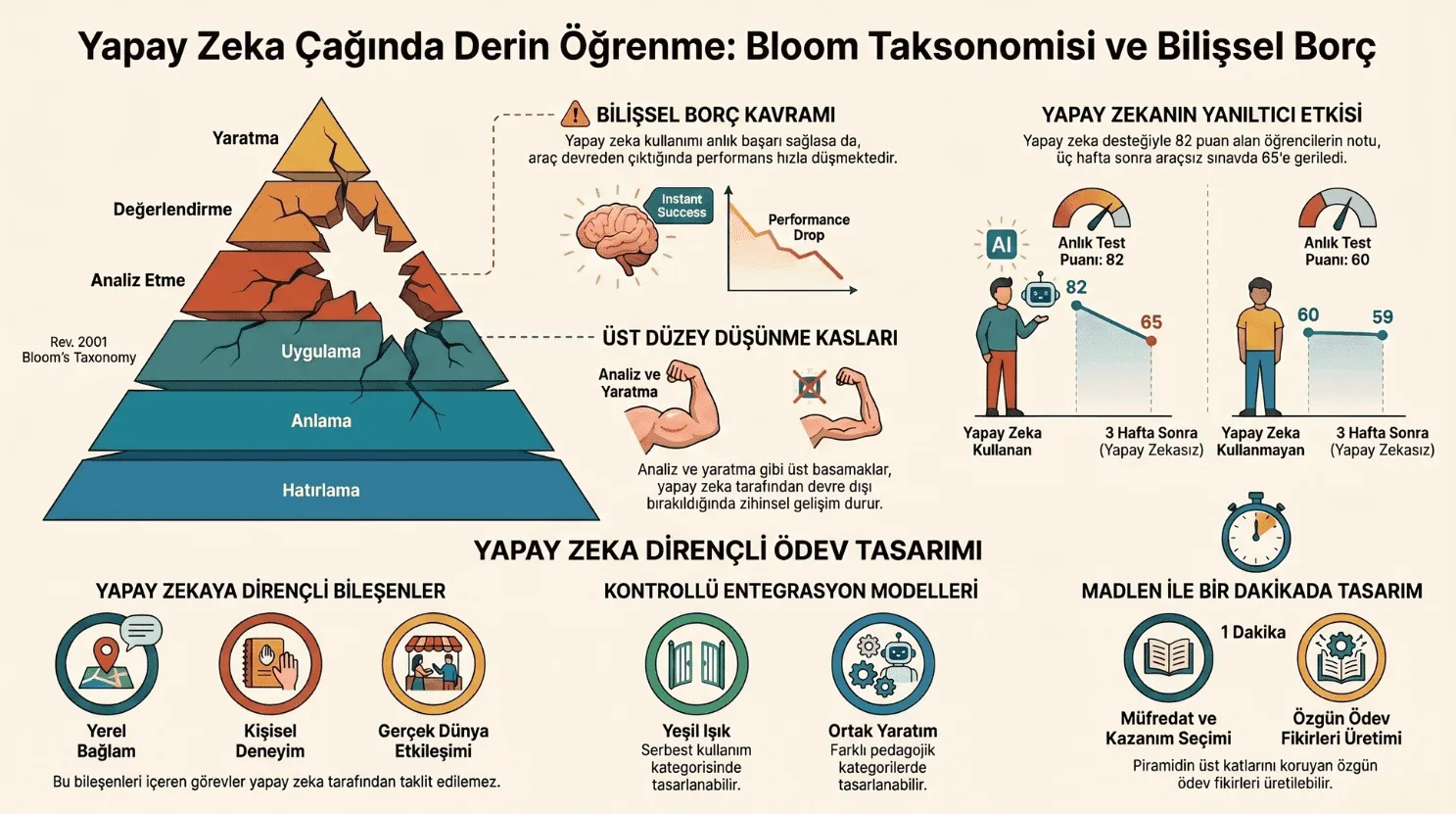
AI has a curious relationship with this structure. In a study conducted in 2025, two groups of students were followed: one group studied using AI, the other without it. Throughout the study, the AI group looked good, scoring 82 out of 100 on the immediate test. The other group stayed at 60. This was a clear sign that AI is supportive when it comes to remembering and understanding.
But when the researchers tested both groups without AI three weeks later, the AI group’s score dropped to 65 while the other group slipped to 59. In other words, a gap of 22 points had shrunk to 6. This showed that the performance that came with AI had almost entirely vanished once the AI was taken away.
On higher-order tasks, the picture was different from the outset. When it came to analysing, evaluating and creating something new, the students working without AI came out ahead. Not just at a single measurement point, but at every stage the study tracked. This led people to the idea that AI loses its power as you climb towards Bloom’s upper levels. The researchers called this “cognitive debt”.
Why Does This Happen?
Higher-order thinking is not a simple transfer of information. It requires pupils to work the information they hold, to look at it from different angles, to construct their own interpretations. That process takes time and demands effort. When AI takes this process out of the loop, pupils may reach the answer, yet they have never experienced the path of thinking behind it. And that means the mental muscles needed to climb to the top of the pyramid never develop, because they have been left idle.
The Context of the Research
Important as these studies are, they come with a context. Most of them, given the period in which they were carried out, excluded AI tools developed specifically for education. Under those conditions, the build-up of cognitive debt is not surprising; it is exactly the result you would expect!
The Problem Is Not the Tool, but the Design
As OECD Director for Education Andreas Schleicher puts it: “When AI removes the productive struggle that learning requires, students may complete tasks faster and look better on immediate results, but their understanding may not have been consolidated as deeply.” Today, however, we face a different picture. There are now systems in which AI can integrate with pedagogical frameworks such as Bloom’s taxonomy, supporting recall while leaving analysis to the pupil. The problem is not the tool, but the design. And it is from this reality that we built Madlen.
Just One of 56 Tools: AI Resistant Homework
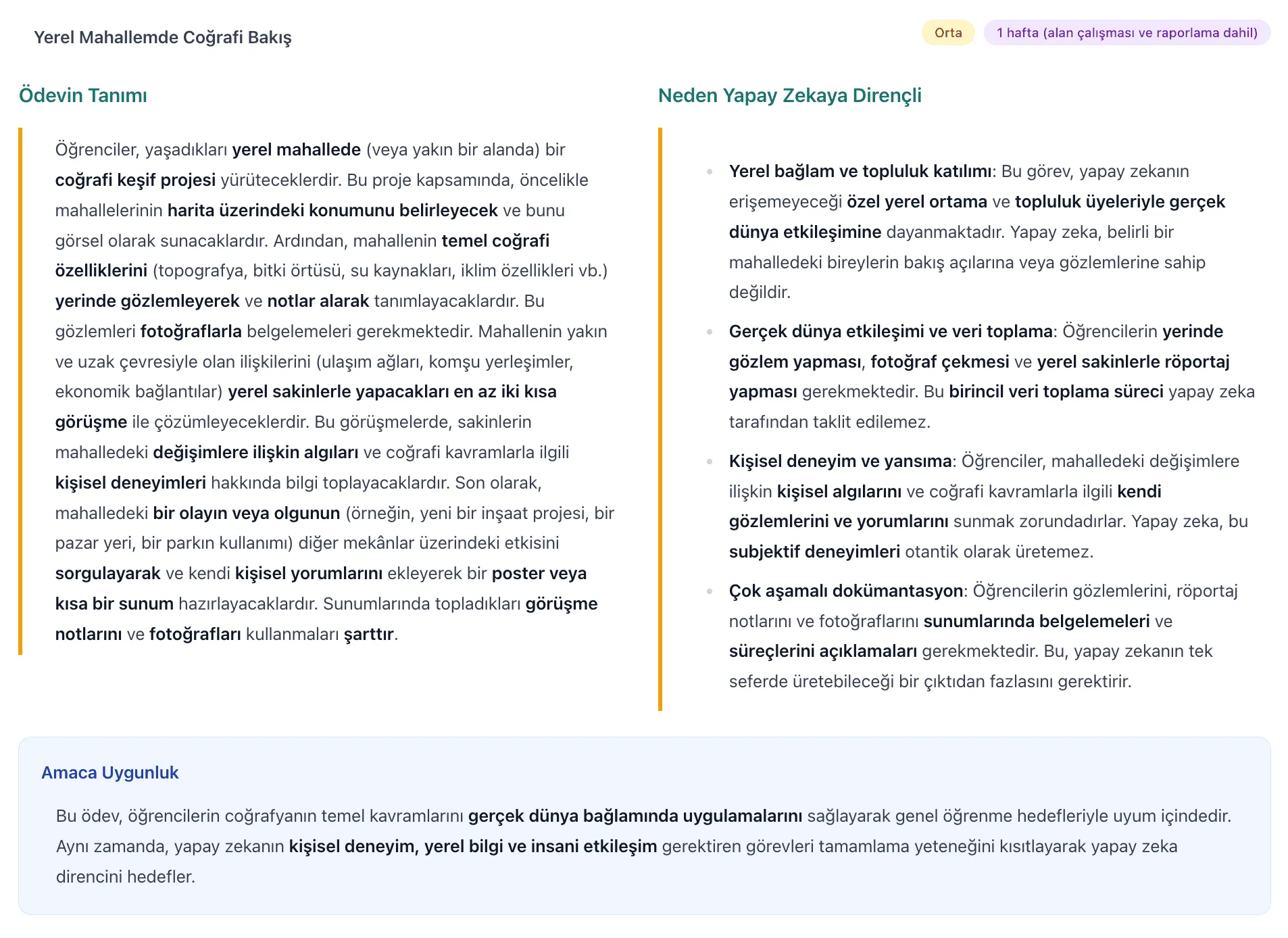
Madlen’s AI Resistant Homework tool exists for exactly this reason! With this tool, our teachers select the relevant curriculum, learning outcome and year group and, within a minute, reach homework ideas that pupils can complete using concrete skills and their own thinking process.
The definition of the homework, why it is resistant to AI, how it fits its purpose, suggested resources, feedback tips and assessment criteria for the teacher, along with self-assessment questions and success indicators for the pupil; all of it arrives in one go. The upper floors of the pyramid are protected here.
AI-Supported Homework Design
Keeping AI out entirely, at all times, is no longer realistic, nor is it necessary. This tool was designed precisely with that reality in mind. In some assignments AI is completely free: the pupil uses it however they wish and reflects on the process. In others, certain sections are open and others closed; AI steps in under controlled conditions. In some assignments the pupil questions, critiques and fills the gaps in what the AI produces. In others, the AI assesses the pupil’s work against set criteria and gives feedback. And in others still, pupil and AI create together; the creative decisions always stay with the pupil.
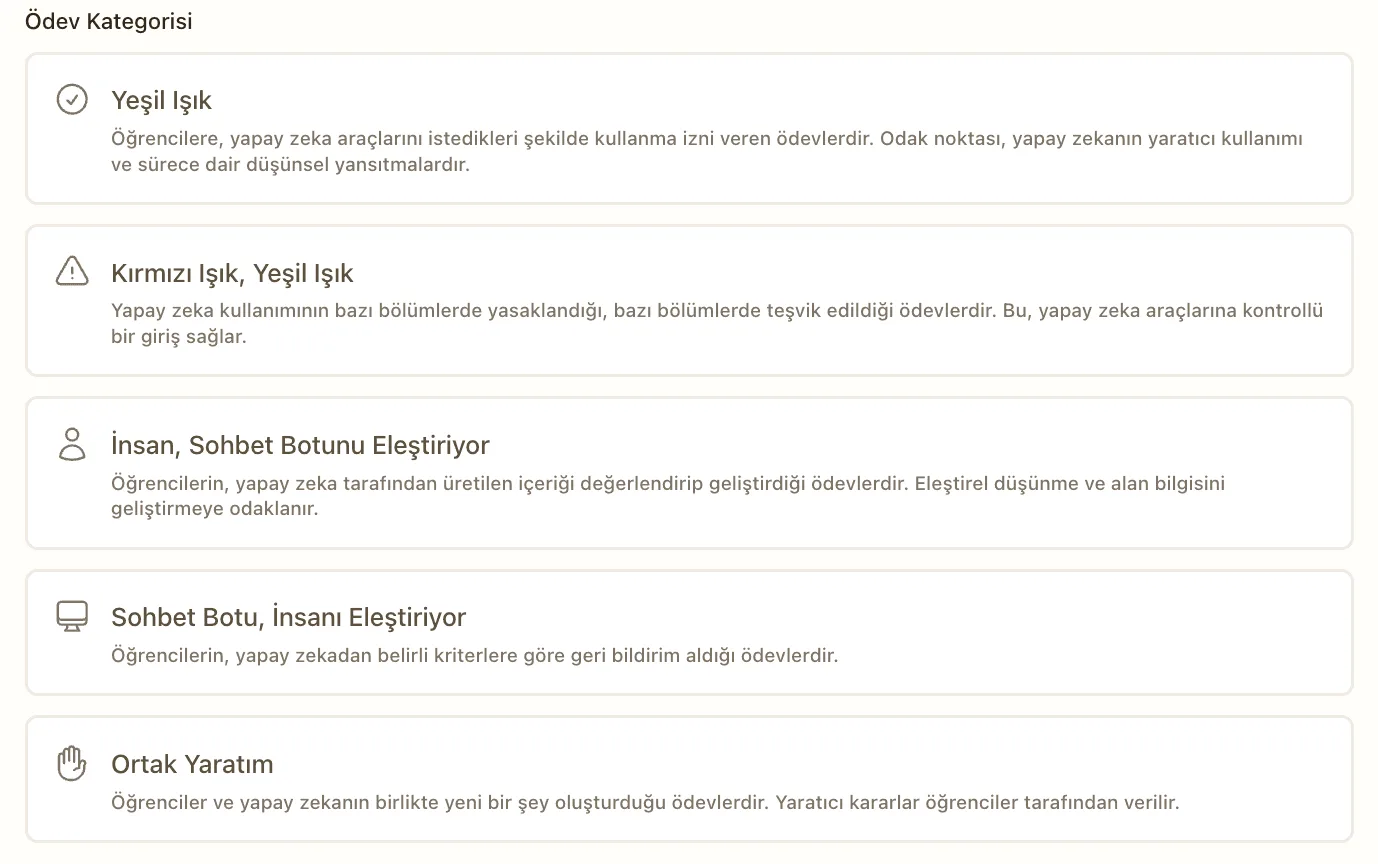
Whichever category the teacher chooses, Madlen automatically generates the matching pupil instructions, homework steps, reflection questions, assessment criteria and topic examples.
What matters is not whether AI is used, but where, how and for what purpose it is used. As Sal Khan said on the TED stage in 2023: “We are on the cusp of the biggest positive transformation education has ever seen, and AI will deliver it.” Sixty years ago, Bloom told us that learning is built like a building. AI can raise that building faster, but the right decisions still have to be made about which floor is laid, when and how. At Madlen, we are doing everything we can to make sure that process runs as it should.
Sources
-
Anderson, L. W. and Krathwohl, D. R. (Eds.) (2001). A Taxonomy for Learning, Teaching, and Assessing: A Revision of Bloom’s Taxonomy of Educational Objectives. Longman.
-
Akgun, S. and Toker, S. (2025). Effects of generative AI use on student learning outcomes in higher education. International Conference on Artificial Intelligence in Education (AIED).
-
Schleicher, A. (2026, January). How to effectively use generative AI in education. OECD Education and Skills Today. https://oecdedutoday.com/how-to-effectively-use-generative-ai-in-education/
-
Khan, S. (2023). How AI could save (not destroy) education. TED. https://www.ted.com/talks/sal\_khan\_how\_ai\_could\_save\_not\_destroy\_education
-
Ler, R. L. (2025). The cognitive debt problem. Edtech Insiders.