

Built around a visual
Each question is anchored to a graph, table or diagram, so pupils reach the answer by reading the visual.
Enter a topic and class level to get curriculum-aligned visual questions as a PDF with an answer key.
The examples below were generated in Madlen.
Based on the diagram shown, which represents the internal arrangement of atoms in a metallic substance: Metals have a specific type of structure. In this structure, atoms lose their outer shell electrons. These electrons move freely throughout the whole metal sample.
Which description best explains the bonding found in a metallic lattice?
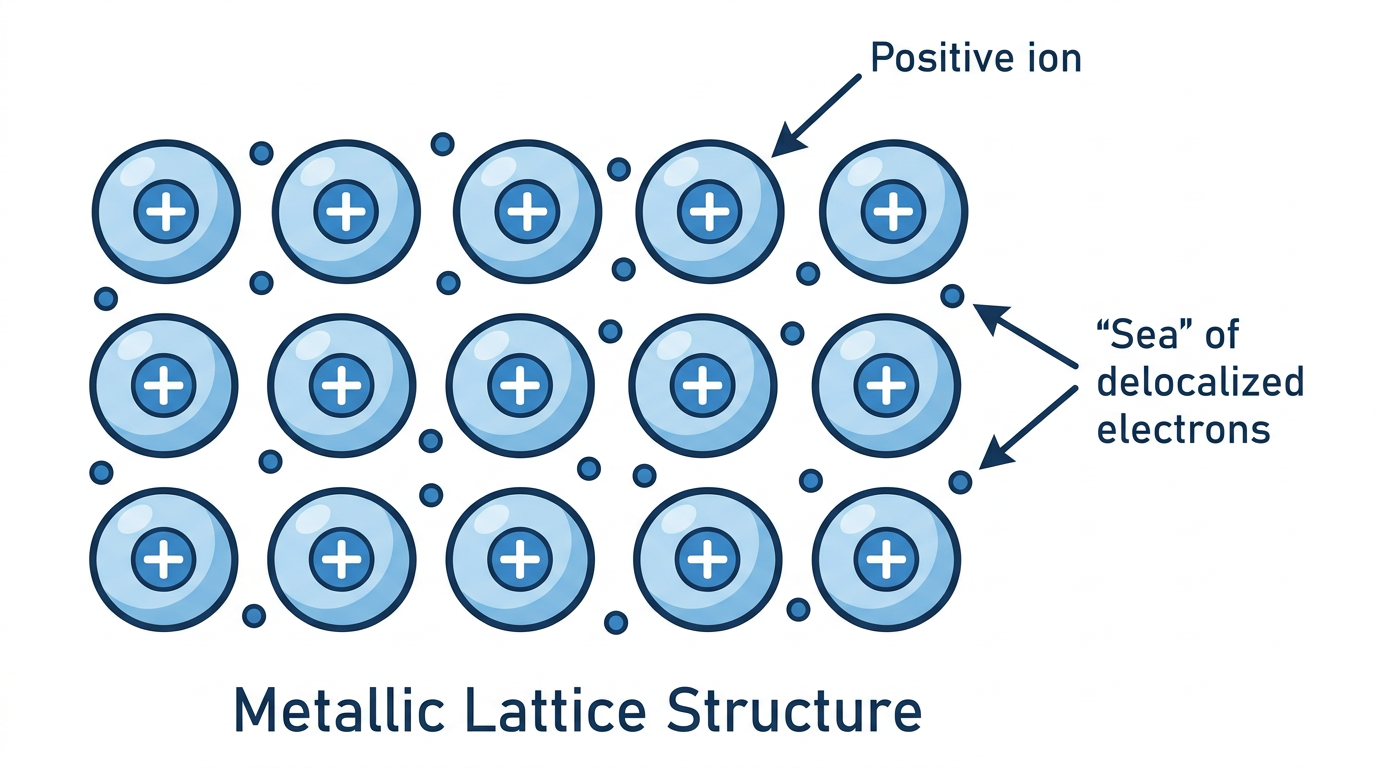
Solution: Metallic bonding consists of a giant lattice of positive metal ions. These ions are surrounded by a sea of delocalised electrons that are free to move. The strong electrostatic attraction between these positive ions and the delocalised electrons holds the structure together. Covalent bonds involve sharing electron pairs, while ionic bonds involve the transfer of electrons between atoms. A mixture contains different substances that are not chemically bonded.
Different substances conduct electricity in different ways. Some materials allow electricity to pass through them because they have particles that can move and carry a charge. Referring to the illustration showing the internal structure of a metal, why do metals show good electrical conductivity in the solid state?
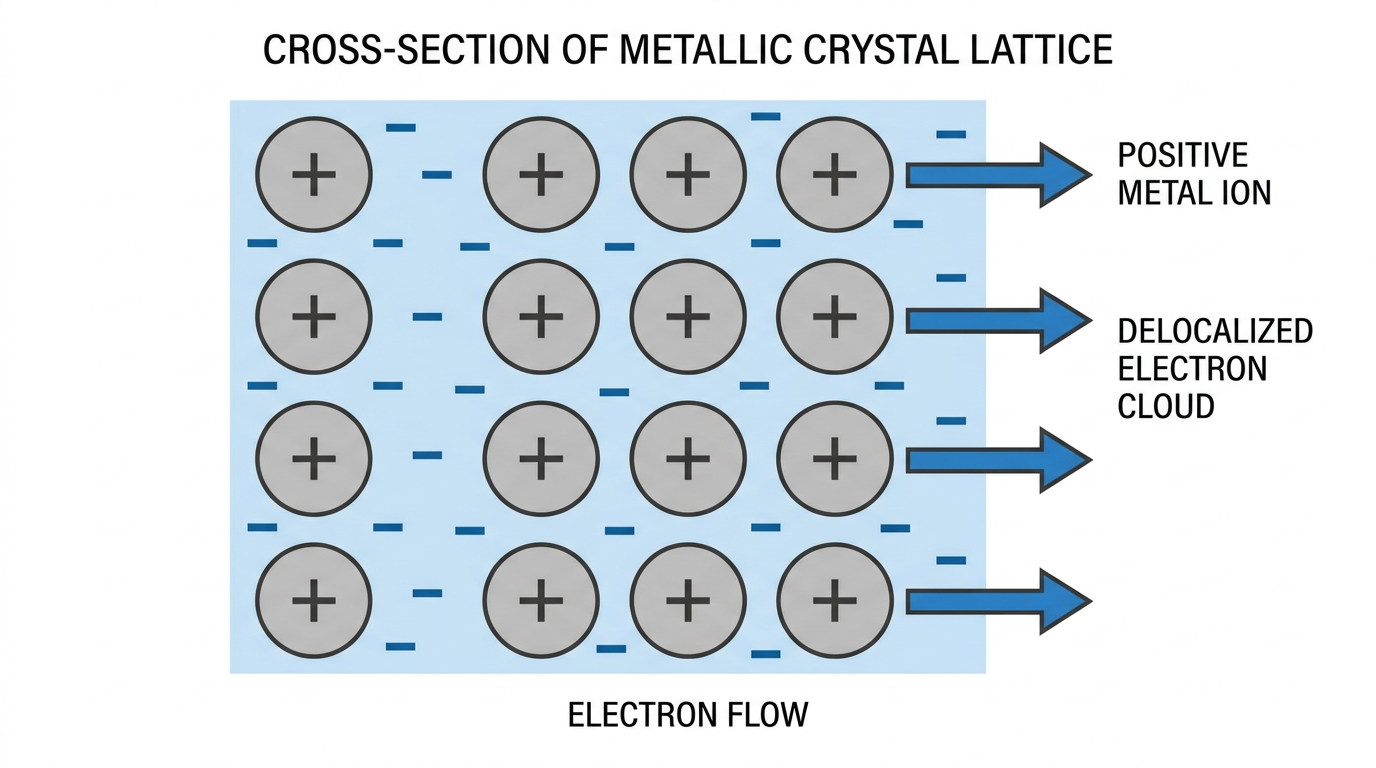
Solution: Metals are good conductors of electricity because the delocalised electrons are free to move through the giant metallic lattice when a voltage is applied. In contrast, simple molecular compounds like water or methane have no free electrons or ions to carry a charge, making them poor conductors. Ionic compounds only conduct when molten or aqueous because the ions are then free to move, but not in the solid state. Graphite is a non-metal that conducts, but most non-metals do not.
Referring to the illustration of metallic lattice behaviour under pressure, metals can be hammered into thin sheets or pulled into long wires. This is possible because of the way the particles are arranged and how they react to pressure.
What allows a metal to be malleable and change shape without breaking?
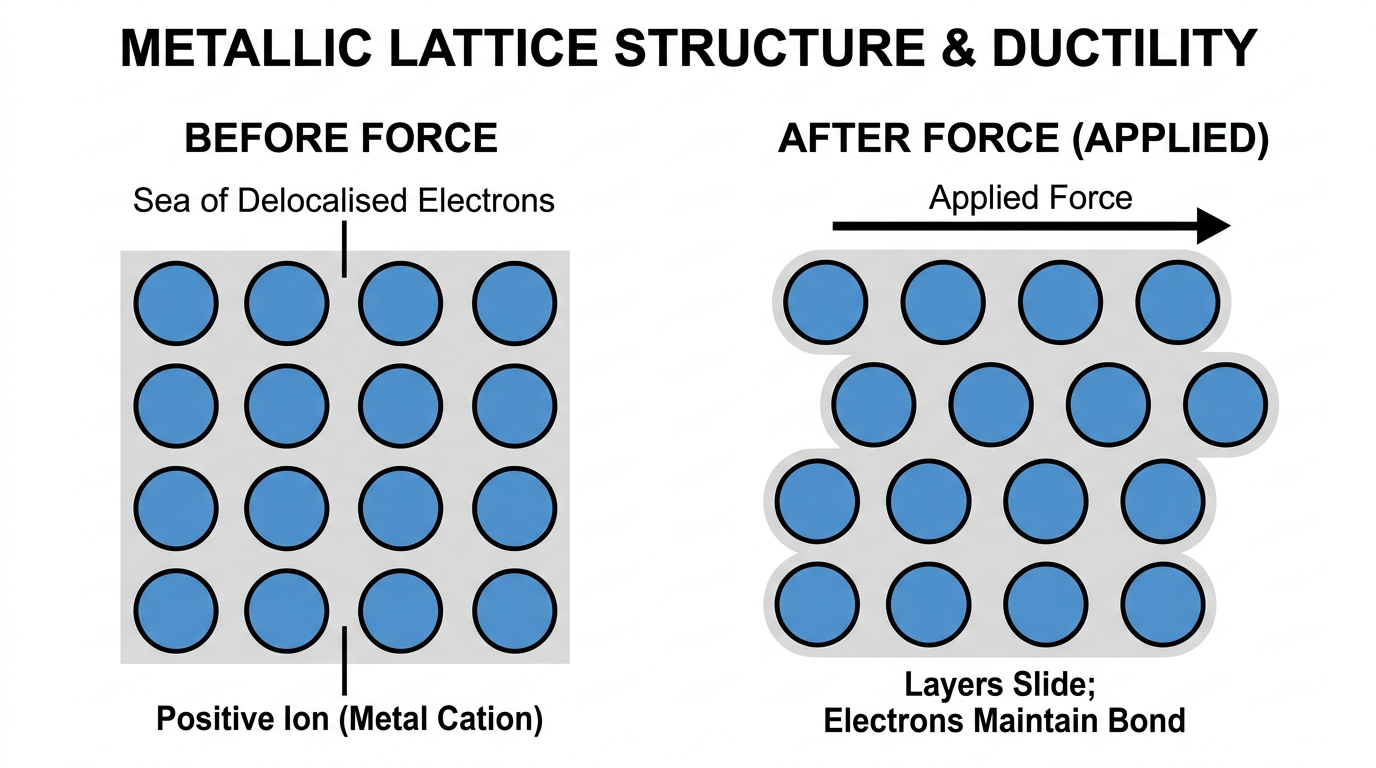
Solution: Metallic lattices are malleable and ductile. This is because the layers of positive ions can slide over each other when a force is applied. The sea of delocalised electrons moves with the ions, so the metallic bond is not broken. In giant covalent structures like diamond, the bonds are rigid and break if the atoms move, making them brittle. Compounds and mixtures have different physical properties based on their specific compositions.
The Periodic Table organises elements based on their atomic structure. The proton number determines the identity of the atom. The number of shells and outer electrons determine an element's position in periods and groups. Based on the provided illustration of a sodium atom, explain the electronic configuration of this atom and identify its position (period and group) on the Periodic Table.
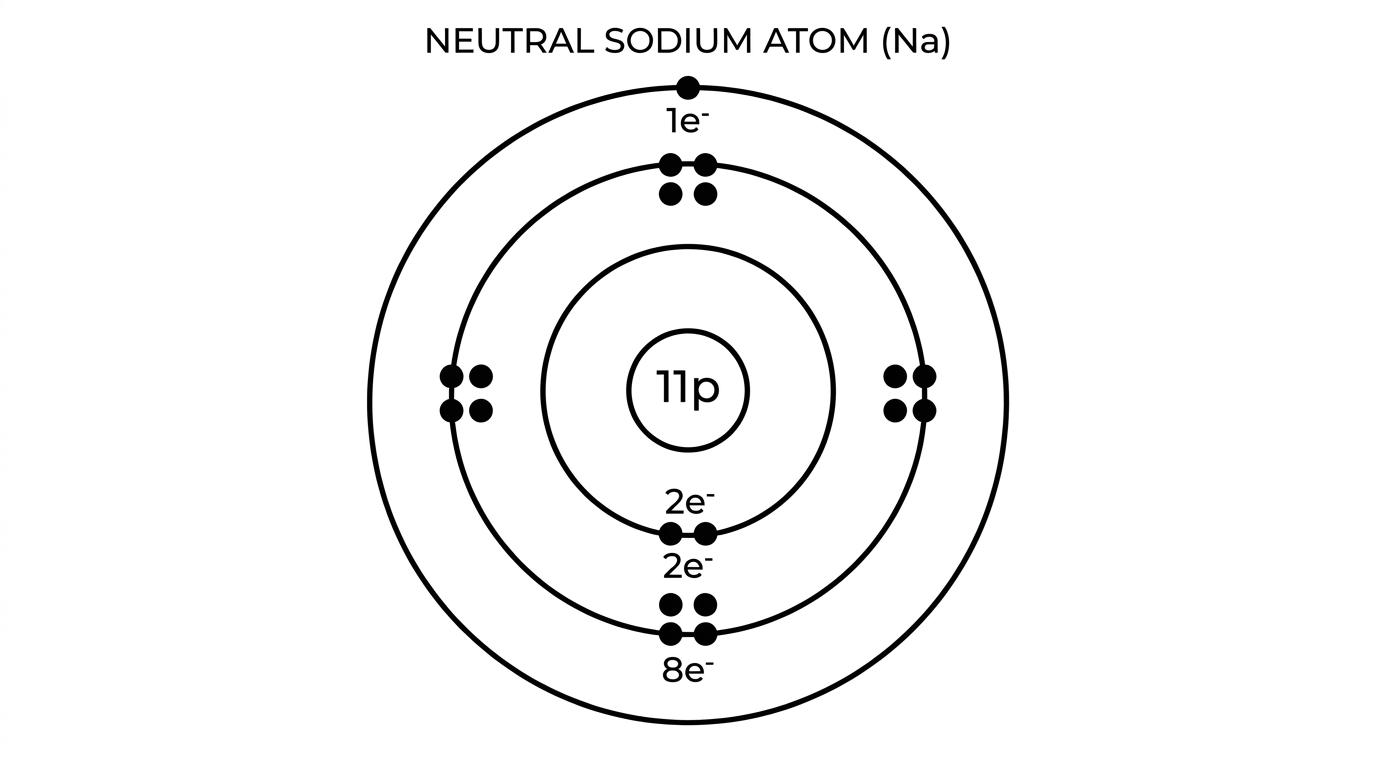
Sample answer: A sodium atom has a proton number of 11. It has 11 electrons. The electronic configuration is 2,8,1. It has three occupied electron shells, so it is in Period 3. It has one electron in its outer shell, so it is in Group I.
Marking criteria:
As depicted in the figure, atoms of the same element like carbon can have different masses depending on their nuclear composition. Based on the provided illustration and your knowledge of chemistry, define what isotopes are and explain why different isotopes of the same element show the same chemical properties.
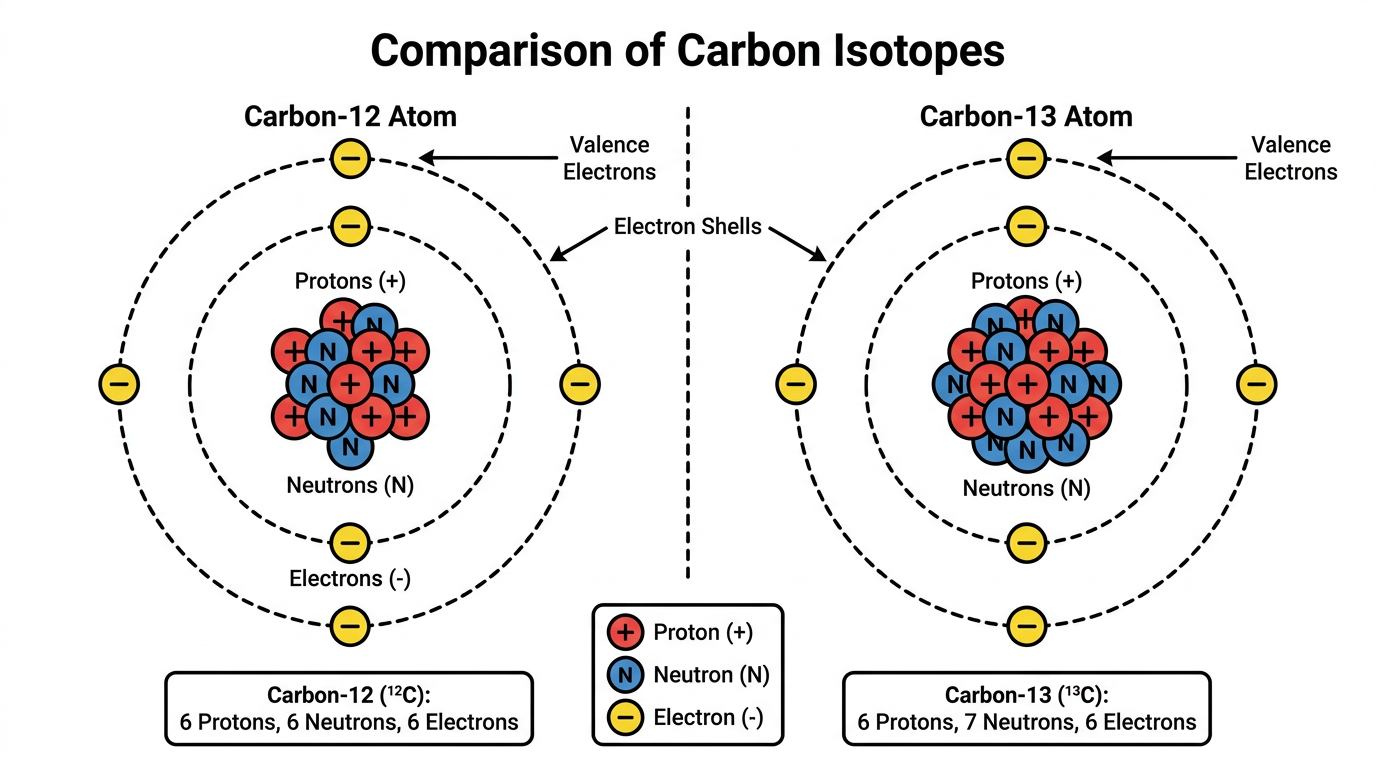
Sample answer: Isotopes are atoms of the same element. They have the same number of protons but different numbers of neutrons. Isotopes of the same element have the same chemical properties. This is because they have the same number of electrons and the same electronic configuration.
Marking criteria:
Ionic compounds like sodium chloride form when different types of elements react. As depicted in the figure, these substances have a regular arrangement of ions called a giant lattice. Their bonding affects their physical state and properties. Based on the chemical processes shown in the image, describe how an ionic bond is formed between a metal and a non-metal and explain why ionic compounds usually have high melting points.
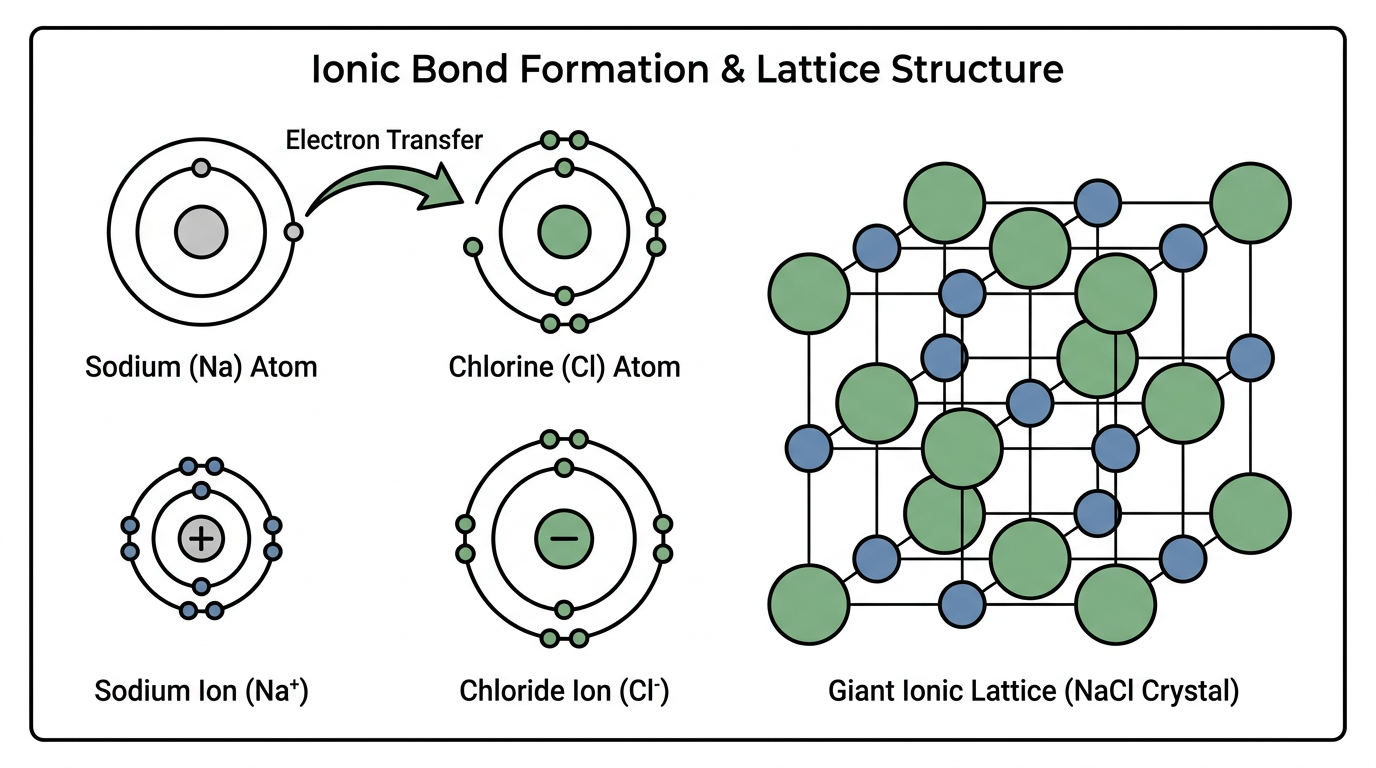
Sample answer: Ionic bonds form when a metal atom gives electrons to a non-metal atom. This creates positive ions and negative ions. An ionic bond is a strong attraction between these oppositely charged ions. These compounds have high melting points because the attractions in the giant lattice are very strong and need a lot of energy to break.
Marking criteria:
Each question is anchored to a graph, table or diagram, so pupils reach the answer by reading the visual.
Questions follow the curriculum for your topic, and every one comes with a short explanation of the correct answer.
Download the questions with an answer key and use them in a test, a worksheet or a revision lesson.
In Madlen a set of visual questions is ready in three steps.
Enter the topic and the year group for your questions.
Madlen builds curriculum-aligned questions around graphs, tables and images, so pupils reach the answer by reading the visual.
Download the questions as a PDF with the answers and a short explanation for each one, ready for a test or a revision lesson.
In Madlen’s Visual Question Generator you enter a topic and a class level. The AI designs questions built around graphs, tables and images in seconds. You can download them as a PDF with an answer key.
A visual question generator creates questions that pupils answer by reading a graph, table or image. Madlen’s Visual Question Generator builds these questions with AI and aligns them with the curriculum. It is one of more than 50 tools in the Madlen Toolbox.
You choose the topic and class level in Madlen, so the Visual Question Generator is not tied to one subject. It suits KS3 and GCSE science, geography and history, and one of our samples is a chemistry set on metallic bonding with diagrams.
Yes, Madlen exports visual questions as a PDF with an answer key. Each question also includes a short explanation of why the correct answer is right, which helps with marking.
Madlen has a free plan for UK teachers, and it starts with 14 days of Pro. You can compare what each plan includes on the Madlen pricing page.
Every new account starts with 14 days of Pro, so you can try the tools on this page with your own classes.